The mind-muscle connection is real, backed by EMG studies. Learn when to use it, when to skip it, and practical cues for each muscle group.
"Squeeze the muscle." "Feel it working." "Think about your biceps during the curl." This is the mind-muscle connection - the practice of consciously focusing on the target muscle during an exercise. Bodybuilders have sworn by it for decades. But is it real, or just gym mythology?
The research says it is real - with important caveats about when it works and when it does not.
What the Science Shows
A 2016 study by Calatayud et al. used EMG (electromyography) to measure muscle activation during bench press. When participants were instructed to focus on their pecs during the press, pec activation increased by 22% compared to simply pressing the weight. Similar results have been found for bicep curls, lateral raises, and other isolation exercises.
A 2018 study by Schoenfeld and Contreras went further - they tracked actual muscle growth over 8 weeks. The group that used internal focus (mind-muscle connection) during bicep curls gained significantly more bicep muscle than the group that focused externally (just moving the weight). The same study found no difference in quad growth during leg extensions between the two groups at high loads.
When the Mind-Muscle Connection Works
Isolation exercises - curls, lateral raises, cable flyes, leg extensions, tricep pushdowns. These are the exercises where thinking about the target muscle genuinely increases activation and, over time, growth. The movement is simple enough that you can split attention between moving the weight and feeling the muscle.
Light to moderate loads (less than 60% of 1RM) - at lighter weights, you have enough capacity to focus on the muscle. As loads get heavier, your attention necessarily shifts to just moving the weight.
Muscles you struggle to feel - many lifters cannot feel their lats working during rows, or their glutes firing during hip thrusts. Mental focus and activation cues can reignite these connections.
When to Skip It
Heavy compound lifts - during a heavy squat, deadlift, or bench press, your focus should be external: push the floor away, drive the bar up, grip hard. Research shows external focus (thinking about the outcome of the movement) produces better performance on heavy compounds than internal focus (thinking about specific muscles).
Trying to "feel your quads" during a near-maximal squat is counterproductive. Just move the weight with good technique.
High-speed or explosive movements - Olympic lifts, plyometrics, sprints. These movements happen too fast for conscious muscle focus to be useful.
Practical Cues by Muscle Group
Chest (bench press, fly): Imagine squeezing a pencil between your pecs at the top of each rep. Think about bringing your upper arms toward each other.
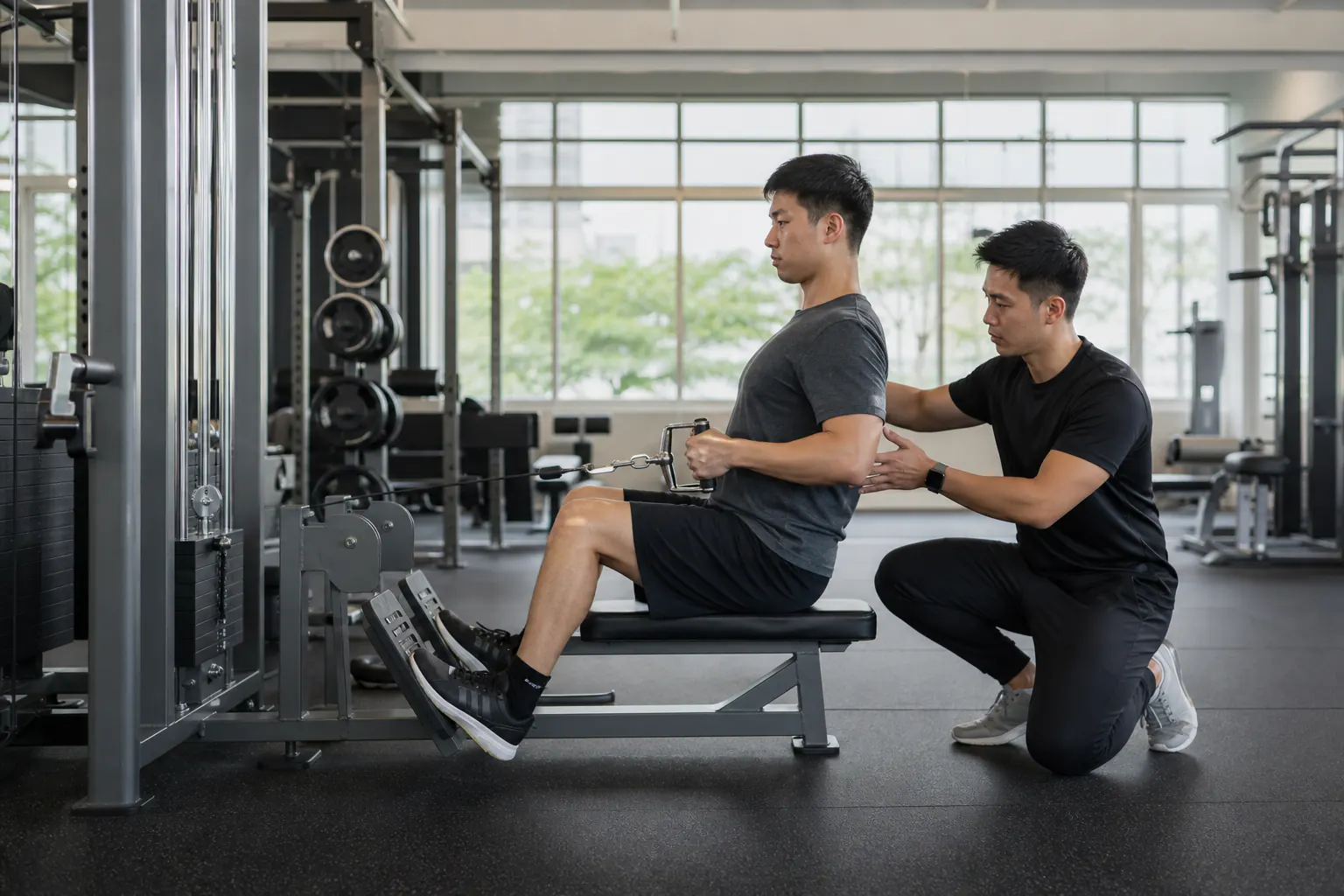
Back (rows, pulldowns): Think about pulling with your elbows, not your hands. Imagine cracking a walnut between your shoulder blades at peak contraction.
Shoulders (lateral raise): Lead with your elbows, not your hands. Imagine pouring water from a jug at the top position.
Biceps (curls): Slow the eccentric to 3 seconds. At the top, squeeze as hard as you can for 1 second. Think about shortening the muscle, not lifting the weight.
Glutes (hip thrust, glute bridge): Squeeze your glutes as hard as possible at the top and hold for 2 seconds. Imagine cracking a walnut between your cheeks.
Quads (leg extension): At the top of each rep, fully extend your knee and squeeze for 1 second. Think about straightening your leg, not lifting the weight.
How to Develop the Connection
If you cannot feel a muscle working, it is likely undertrained or neurally inhibited. Here is how to build the connection:
Pre-activation sets. Before your main exercise, do 1-2 light sets of an isolation movement for the target muscle. Before bench press, do 15 reps of cable flyes focusing on the pec squeeze. This primes the neural pathway to the muscle.
Slow tempo training. Use 4 seconds eccentric, 2 seconds concentric. The slower pace gives your brain time to register what the muscle is doing.
Touch the muscle. Place your free hand on the working muscle during single-arm exercises. The tactile feedback helps your brain connect to the muscle. This is not vanity - it is a legitimate training technique used by physiotherapists and coaches.
Lower the weight. If you cannot feel the muscle working, the weight is too heavy. Drop it by 30-40% and focus on contraction quality. The connection comes first; the load comes later.
The Bottom Line
Use internal focus (mind-muscle connection) on isolation exercises with moderate loads. Use external focus (move the weight) on heavy compounds. This combination gives you the best of both worlds - maximum strength development on compounds and targeted hypertrophy on isolation work.
The mind-muscle connection is not magic, but it is a genuine training tool that produces measurable results when applied correctly.
Part of our comprehensive guide:
The Complete Guide to Personal Training Methods in Malaysia→Also in this series:
Related Articles
Find a Personal Trainer
Ready to put this into practice? Connect with a certified personal trainer near you, or explore by service and goal.