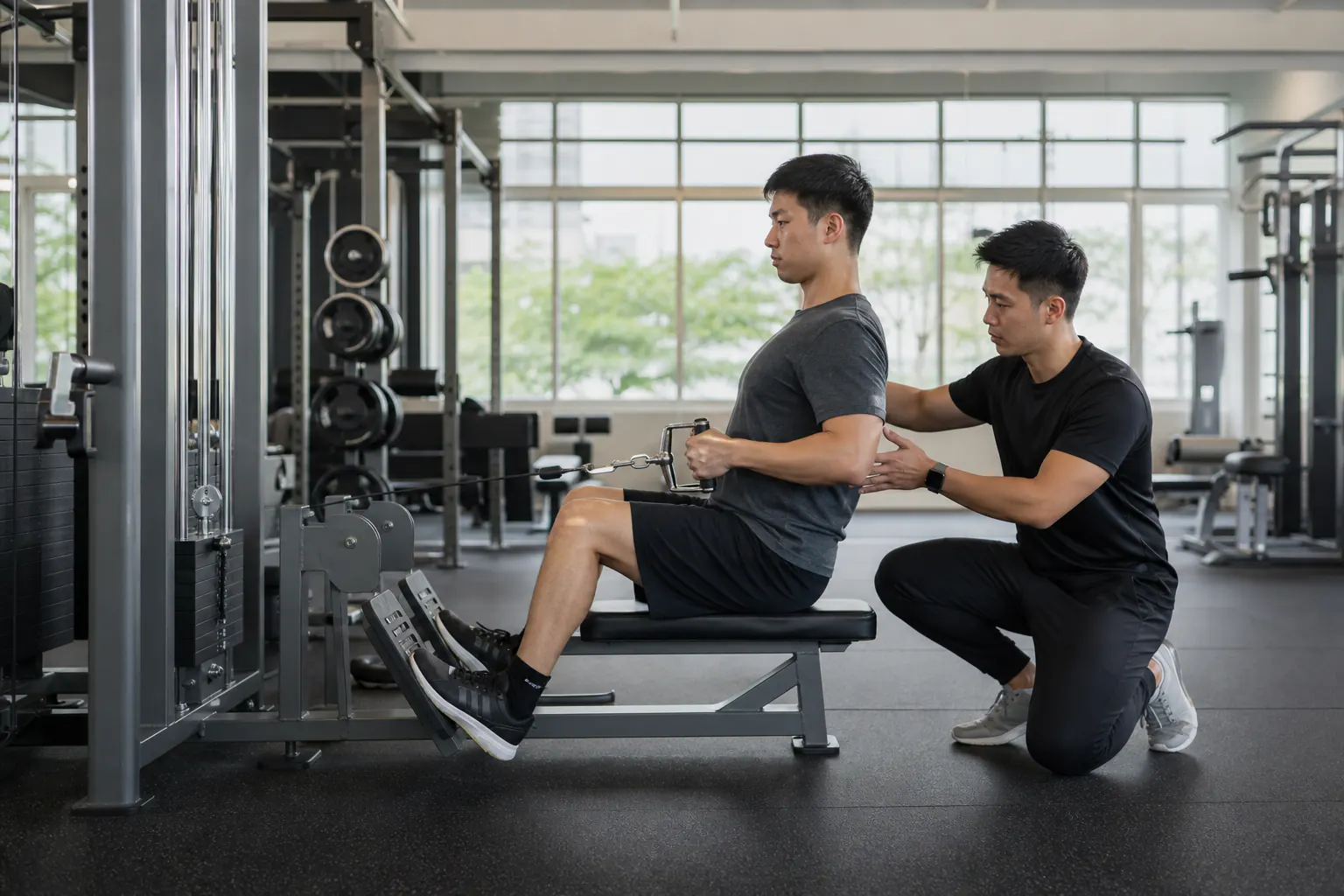
Learn the crucial difference between mobility and flexibility, and why both matter for your fitness. A practical guide for Malaysian gym-goers and athletes.
Two Terms, Very Different Meanings
Mobility and flexibility are terms used interchangeably in most Malaysian gyms, but they describe fundamentally different physical qualities. Understanding this distinction is not just academic - it directly affects how you train, how you perform, and how well your body ages.
Getting this wrong means wasting time on stretches that do not address your actual limitations, or wondering why you can touch your toes but still cannot squat properly. Getting it right means moving better, training more effectively, and reducing your injury risk.
Defining the Terms
Flexibility
Flexibility is the passive ability of your muscles and connective tissues to lengthen. It is what happens when someone pushes your leg into a stretch, when you hang in a stretch position, or when gravity pulls you into a range of motion.
The key word is passive - something else is creating the stretch, and your muscles are not actively producing force in that position.
Example: Lying on your back while a friend pushes your straight leg toward your chest to stretch your hamstring. Your hamstring can lengthen to a certain point - that is your flexibility.
Mobility
Mobility is the active ability to move a joint through its full range of motion with strength and control. It requires not just tissue length (flexibility) but also joint health, motor control, and muscular strength at end ranges.
The key words are active, strength, and control.
Example: Standing on one leg and actively lifting the other leg to hip height with control. This requires hamstring flexibility, hip flexor strength, core stability, and neural control - that is mobility.
Why the Distinction Matters
You Can Be Flexible but Not Mobile
Many people, especially those who practise static stretching or passive yoga, have excellent flexibility but poor mobility. They can be pushed into deep stretches but cannot actively move into or control those positions. This creates a dangerous gap - their joints can reach ranges of motion that their muscles cannot stabilise, increasing injury risk.
A common example in Malaysian gyms: someone can sit in a deep passive squat stretch but collapses when trying to squat with a barbell. Their muscles have the length, but not the strength and control, at the bottom range.
You Can Be Mobile Without Being Extremely Flexible
A gymnast might not be able to do the splits (extreme flexibility) but can perform powerful, controlled movements through an impressive range of motion. Their joints move well, and their muscles are strong throughout those ranges. This is functional mobility.
The Practical Takeaway
If you only train flexibility (passive stretching), you build range of motion without the ability to use it. If you train mobility (active range of motion with control), you build usable movement capacity that translates to better exercise performance and injury resilience.
Common Mobility Limitations in Malaysians
Ankle Mobility
Tight ankles are epidemic among Malaysians who wear shoes all day and sit for long hours. Limited ankle dorsiflexion (the ability to bring your shin forward over your foot) directly limits squat depth, running mechanics, and balance.
Test: Face a wall, place your foot about 10 cm away, and try to touch your knee to the wall without your heel lifting. If you cannot, your ankle mobility is restricted.
Hip Mobility
The hips are designed for a vast range of motion - flexion, extension, rotation, abduction, and adduction. Prolonged sitting shortens the hip flexors and weakens the glutes, drastically reducing hip mobility. This affects squatting, lunging, running, and virtually every lower body movement.
Thoracic Spine Mobility
The upper back should be capable of significant extension and rotation. Hours of hunching over laptops and phones in offices across Kuala Lumpur, Penang, and everywhere else lock the thoracic spine in a flexed, rounded position. This limits overhead pressing, reduces breathing capacity, and contributes to shoulder problems.
Shoulder Mobility
Full overhead reach requires adequate mobility in the shoulder joint, thoracic spine, and surrounding muscles. Many Malaysian gym-goers cannot fully extend their arms overhead without arching their lower back - a compensation for poor shoulder mobility.
Mobility Exercises for Key Areas
Ankle Mobility
Wall ankle mobilisation: In a split stance facing a wall, drive your front knee forward over your toes, keeping your heel down. Perform 10 to 15 reps per side, gradually increasing the distance from the wall.
Banded ankle mobilisation: Wrap a resistance band around a fixed point at floor level and loop it around your front ankle. Step forward to create tension. Perform the same knee-over-toe motion with the band pulling the ankle joint forward, encouraging the talus bone to glide properly.
Hip Mobility
90/90 hip switches: Sit with one leg in front of you and one behind, both bent at 90 degrees. Rotate both legs to the opposite 90/90 position without using your hands. Perform 10 switches. This develops active hip rotation.
Deep squat hold: Squat as deep as you can with feet shoulder-width apart and toes slightly out. Hold the bottom position for 30 to 60 seconds, gently pushing your knees out with your elbows. This builds active hip mobility in the squat pattern.
Controlled articular rotations (CARs): Stand on one leg and make large, slow circles with the other hip - forward, to the side, and behind. Perform 5 circles in each direction. This takes each hip through its full range of motion with active muscular control.
Thoracic Spine Mobility
Thoracic rotations: Start on all fours. Place one hand behind your head and rotate your upper body to look toward the ceiling, then rotate down toward the opposite arm. Perform 10 per side.
Open book stretch: Lie on your side with knees stacked and bent at 90 degrees. Open your top arm to the opposite side, rotating your thoracic spine while keeping your knees together. Follow your hand with your eyes. Hold for 5 seconds, return. Perform 8 to 10 per side.
Foam roller thoracic extension: Lie face up with a foam roller across your mid-back. Interlace your fingers behind your head and gently extend over the roller. Move the roller to different segments of your thoracic spine. Spend 2 minutes total.
Shoulder Mobility
Wall slides: Stand with your back and arms against a wall, elbows at 90 degrees. Slide your arms up the wall while maintaining full contact. If your arms or lower back pull away from the wall, that reveals your limitation.
Band pull-aparts: Hold a light resistance band at arm's length with hands shoulder-width apart. Pull the band apart until it touches your chest. Return slowly. Perform 15 to 20 reps. This builds the upper back strength that supports shoulder mobility.
Building a Mobility Routine
The Daily Minimum (5 Minutes)
Pick one or two areas that feel tightest and perform 2 to 3 mobility exercises for those areas. Rotate between ankle, hip, thoracic, and shoulder work across the week.
The Pre-Workout Routine (8-10 Minutes)
Focus on the joints most involved in your training session. On squat day, prioritise ankle and hip mobility. On pressing day, focus on thoracic and shoulder mobility. Complete 3 to 4 exercises with 8 to 10 reps each.
The Comprehensive Session (20 Minutes)
Once or twice per week, dedicate a full 20-minute session to mobility work covering all major joints. This can be done at home while watching television or as a dedicated gym session.
Static Stretching: Not Useless, Just Context-Dependent
Static stretching still has a role. Use it after training to promote relaxation and maintain tissue length. Avoid aggressive static stretching before heavy lifting, as it can temporarily reduce force production. Light static stretches (held less than 30 seconds) before exercise are fine, but dynamic mobility work is more appropriate for warm-ups.
The Long-Term View
Mobility deterioration is gradual - you do not notice it until a movement that was once easy becomes restricted or painful. The daily investment of 5 to 10 minutes in mobility work compounds over years, keeping you moving well, training effectively, and living comfortably as you age. Start treating mobility as seriously as you treat strength training, and your body will function better in every way.
Part of our comprehensive guide:
The Complete Guide to Personal Training Methods in Malaysia→Also in this series:
Related Articles
Find a Personal Trainer
Ready to put this into practice? Connect with a certified personal trainer near you, or explore by service and goal.