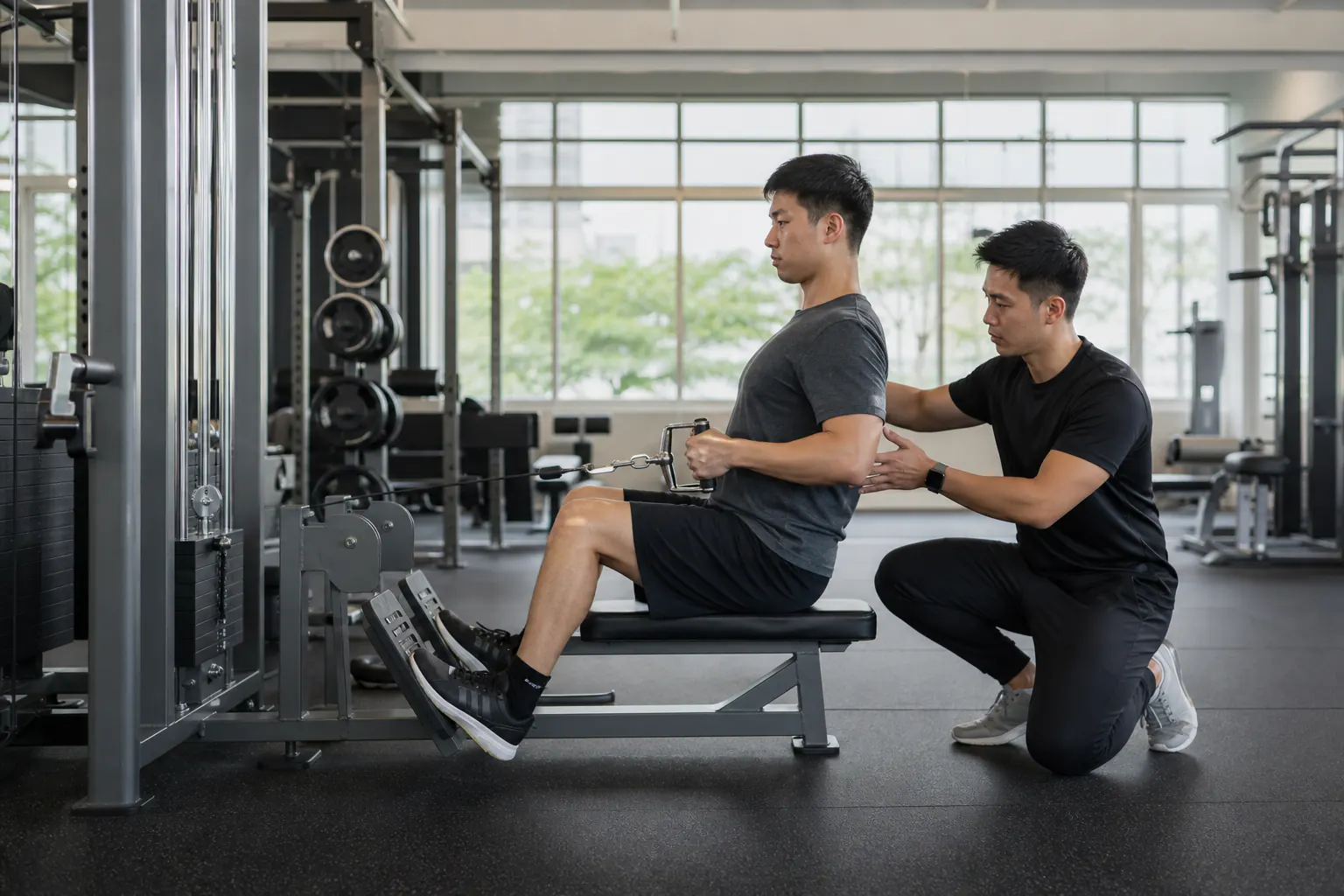
Build stronger abs without a single crunch. 10 effective core exercises that protect your spine and build real functional strength for Malaysian lifters.
Crunches are the most popular ab exercise in the world and one of the worst. Repeated spinal flexion under load compresses your intervertebral discs, places excessive stress on your cervical spine, and targets a limited portion of your core musculature. Dr. Stuart McGill - the world's leading spine biomechanics researcher - demonstrated decades ago that repeated flexion is a primary mechanism for disc herniation.
Your core does far more than crunch forward. It resists extension, rotation, and lateral flexion. It stabilises your spine under heavy loads. It transfers force between your upper and lower body. Training it properly means going beyond crunches.
Here are 10 exercises that build a stronger, more functional core without a single crunch.
1. Dead Bug
The dead bug is arguably the best core exercise for beginners and advanced lifters alike. It trains anti-extension - your core's ability to prevent your lower back from arching - in a safe, spine-friendly position.
How to do it:
- Lie on your back, arms pointing toward the ceiling
- Knees bent at 90 degrees, shins parallel to the floor
- Press your lower back into the floor - no gap between your back and the ground
- Simultaneously extend your right arm overhead and your left leg straight out
- Return to start. Repeat on the opposite side.
- 3 sets of 8-10 per side
The key: Your lower back must stay glued to the floor. The moment it arches, you have lost the exercise. Reduce range of motion or use lighter limb extensions until you can maintain that flat-back position.
2. Pallof Press
An anti-rotation exercise that forces your obliques and deep core to resist a rotational force. Extremely effective and rarely seen in Malaysian gyms.
How to do it:
- Attach a D-handle to a cable machine at chest height
- Stand sideways to the machine, feet shoulder-width apart
- Hold the handle at your chest with both hands
- Press the handle straight out in front of you
- Hold for 3-5 seconds with arms extended
- Bring it back to your chest
- 3 sets of 10 per side
The cable tries to rotate you toward the machine. Your core fights this rotation. The further you press the handle from your body, the harder your core works. Start light - even 5-10kg on the cable stack is challenging.
3. Plank Variations
The standard plank is fine, but most people do it wrong - sagging hips, head dropping, holding for 3 minutes while scrolling their phone. A properly braced plank should be so intense that 30-45 seconds is genuinely challenging.
The RKC Plank (Hardstyle Plank):
- Standard plank position on forearms
- Squeeze every muscle in your body simultaneously - glutes, quads, fists clenched
- Pull your elbows toward your toes (they will not move, but the intent creates tension)
- Push your forearms into the floor
- Hold for 15-20 seconds of maximum tension
- 3-4 sets
This is infinitely more productive than a lazy 3-minute plank. If 20 seconds feels easy, you are not squeezing hard enough.
4. Ab Wheel Rollout
One of the most brutally effective anti-extension exercises available. An ab wheel costs RM15-30 at Mr DIY or Decathlon.
How to do it:
- Kneel on a mat, hands on the ab wheel
- Roll forward slowly, keeping your core braced and hips extended
- Go as far as you can control without your lower back collapsing
- Pull yourself back to the starting position using your abs - not your hip flexors
- 3 sets of 8-12 reps
If you cannot control the full range, roll toward a wall to limit how far you can extend. Gradually increase the distance as your strength improves.
5. Hanging Leg Raise
This trains hip flexion and core control simultaneously while decompressing your spine (a nice bonus for anyone who squats and deadlifts regularly).
How to do it:
- Hang from a pull-up bar with straight arms
- Raise your legs until your thighs are parallel to the floor (or higher)
- Lower with control - 2-3 seconds down
- No swinging. If you are swinging, reduce the range of motion or bend your knees
- 3 sets of 10-15 reps
Progression:
- Hanging knee raises (bent legs) - easiest
- Hanging leg raises (straight legs to parallel) - intermediate
- Toes to bar (feet touch the bar) - advanced
6. Farmer's Walk
You might not think of carries as a core exercise, but walking with heavy weights in your hands demands enormous core stabilisation. Your obliques and quadratus lumborum work overtime to keep your torso upright and prevent lateral flexion.
How to do it:
- Pick up the heaviest dumbbells you can carry
- Walk 30-40 metres with tall posture
- Shoulders back, chest up, core braced
- 3-4 sets
For a 75kg lifter, aim for 30-35kg per hand. These also build grip strength and trap development - a three-for-one exercise.
7. Bird Dog
Simple, effective, and safe for absolutely everyone. The bird dog trains anti-extension and anti-rotation simultaneously.
How to do it:
- Start on all fours - hands under shoulders, knees under hips
- Extend your right arm forward and left leg backward simultaneously
- Hold for 2-3 seconds, squeezing your glute
- Return to start. Repeat opposite side.
- 3 sets of 10 per side
Focus on keeping your hips level - no rotating or shifting. Place a water bottle on your lower back. If it falls off, you are rotating.
8. Cable Woodchop
A dynamic rotational exercise that trains your obliques through a functional movement pattern.
How to do it:
- Set a cable to the highest position with a rope attachment
- Stand sideways, feet wider than shoulder width
- Pull the rope diagonally across your body from high to low
- Rotate through your torso - your hips and shoulders should turn together
- Control the return
- 3 sets of 12 per side
The power comes from your core rotation, not your arms. Your arms are just connecting rods - the engine is your obliques.
9. Suitcase Carry
A single-arm farmer's walk. You carry a heavy dumbbell or kettlebell on one side only, forcing your obliques on the opposite side to resist lateral flexion.
How to do it:
- Hold a heavy dumbbell in one hand
- Walk 30-40 metres without leaning toward the weighted side
- Your shoulders should stay level - imagine balancing a tray of teh tarik on your head
- Switch sides and repeat
- 3 sets per side
This exercise also reveals asymmetries. If one side feels dramatically harder, your obliques on that side need more work.
10. Stir the Pot
An advanced plank variation using a Swiss ball that most people have never tried.
How to do it:
- Place your forearms on a Swiss ball in a plank position
- Brace your core hard
- Make small circles with your forearms - "stirring a pot"
- 8-10 circles clockwise, then 8-10 counterclockwise
- 3 sets
The instability of the ball forces your core to stabilise in multiple planes simultaneously. This is significantly harder than it looks. If your gym has a Swiss ball (most gyms in Malaysia do), give this a try.
How to Programme These Exercises
You do not need to do all 10 in every session. Pick 2-3 and include them at the end of your training, or use them as warm-up movements.
Sample weekly core plan:
Monday (after lower body):
- Dead bugs: 3x10 per side
- Farmer's walk: 3x40m
Wednesday (after upper body):
- Pallof press: 3x10 per side
- Hanging leg raise: 3x12
Friday (after lower body):
- Ab wheel rollout: 3x10
- Cable woodchop: 3x12 per side
Total core volume: 18 sets per week across multiple movement patterns. Far more effective than 100 crunches three times a week.
Your core is designed to stabilise, resist, and transfer force. Train it that way, and you will build abs that are not just visible but genuinely strong and functional. Crunches are not necessary - and for most people, they are not even the best option.
Part of our comprehensive guide:
The Complete Guide to Personal Training Methods in Malaysia→Also in this series:
Related Articles
Find a Personal Trainer
Ready to put this into practice? Connect with a certified personal trainer near you, or explore by service and goal.