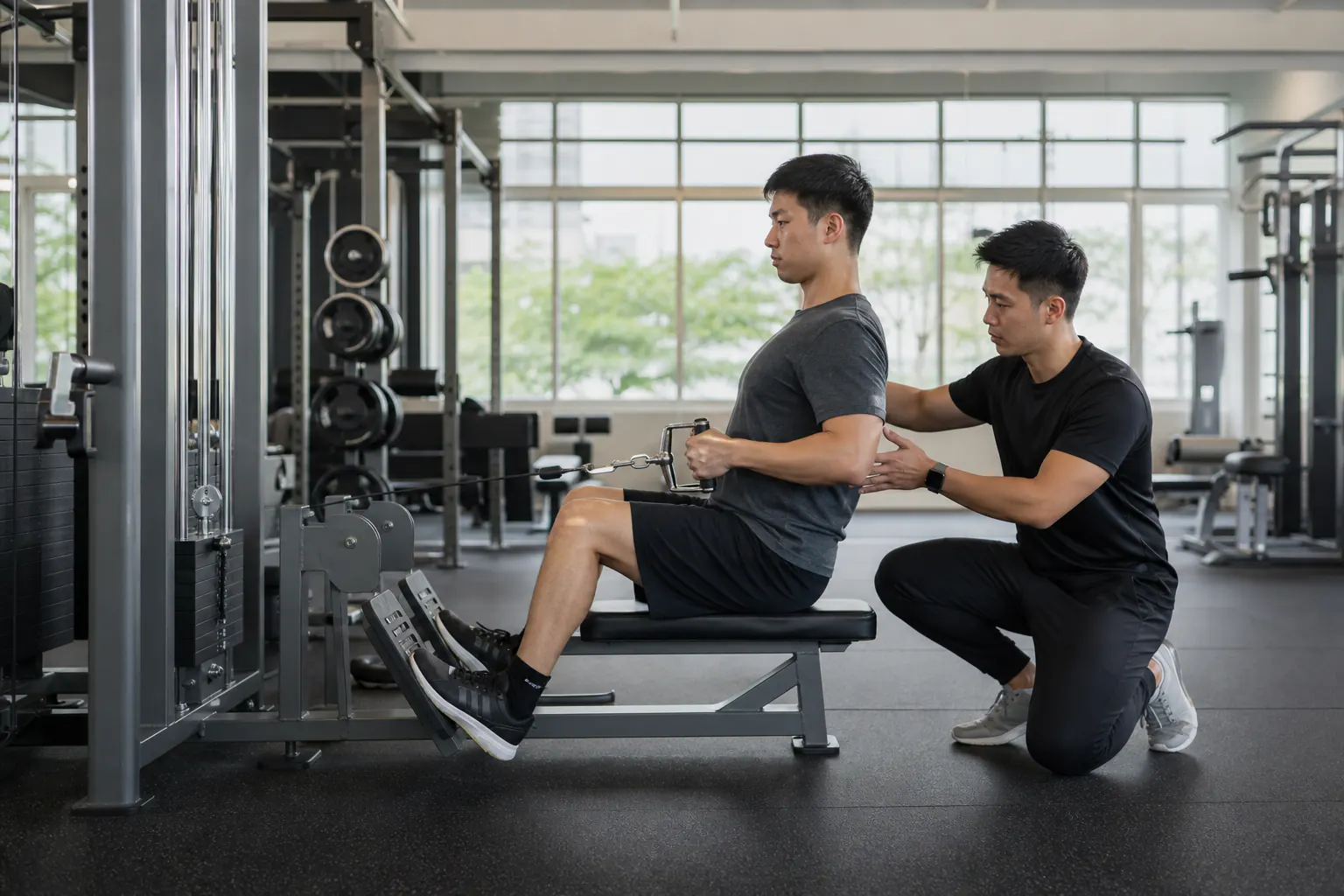
Build bigger traps with more than just shrugs. Complete upper trap, mid-trap, and lower trap exercises for a thick, powerful upper back.
Most lifters train traps with shrugs and nothing else. Shrugs hit the upper traps effectively, but the trapezius is a large muscle with three distinct regions - upper, middle, and lower - each with a different function. Training only upper traps with shrugs is like training only the biceps and wondering why your arms look incomplete.
Trap Anatomy
Upper traps
Run from the base of your skull to the top of your shoulders. Function: elevating the scapulae (shrugging). Trained by: shrugs, upright rows, farmer's walks.
Middle traps
Run from the upper spine to the medial border of your shoulder blades. Function: retracting the scapulae (pulling shoulder blades together). Trained by: face pulls, band pull-aparts, rows with scapular retraction focus.
Lower traps
Run from the mid-spine to the lower border of your shoulder blades. Function: depressing the scapulae (pulling shoulder blades down and back). Trained by: prone Y-raises, overhead shrugs, scapular pull-ups.
The Complete Trap Workout
Upper Traps
Barbell shrug: 4 sets of 10-12. Grip slightly wider than shoulder width. Shrug straight up - do not roll your shoulders (rolling adds nothing and stresses the shoulder joint). Hold the top for 1-2 seconds. Use straps if grip limits the load.
Dumbbell shrug: 3 sets of 12-15. Dumbbells allow a slightly longer range of motion than barbells because they hang at your sides rather than in front. Squeeze hard at the top.
Middle Traps
Face pull with external rotation: 3 sets of 15-20. Cable at face height, rope attachment. Pull toward your face, splitting the rope apart with thumbs pointing backward at the end. This hits both middle traps (retraction) and external rotators.
Chest-supported dumbbell row (wide elbows): 3 sets of 12-15. Lie face down on an incline bench. Row dumbbells with elbows wide (perpendicular to your body) rather than tucked. The wide angle shifts emphasis from lats to middle traps and rear delts.
Band pull-apart: 3 sets of 20. Hold a resistance band at arm's length, pull apart until it touches your chest. Squeeze shoulder blades together at the end.
Lower Traps
Prone Y-raise: 3 sets of 12-15. Lie face down on an incline bench. Raise dumbbells (very light - 2-3 kg) overhead in a Y-shape. This is deceptively difficult because the lower traps are chronically weak in most people.
Scapular pull-up: 3 sets of 8-10. Hang from a pull-up bar, arms straight. Without bending your elbows, pull your shoulder blades down and together. This is a tiny movement - your body rises 5-8 cm - but the lower trap activation is intense.
Programming
Train traps directly 2-3 times per week. Upper traps get indirect work from deadlifts and farmer's walks. Middle and lower traps get indirect work from rows and pull-ups. But direct work accelerates development significantly.
A practical approach:
- Pull day: Include face pulls (middle traps) and shrugs (upper traps)
- Push day: Include band pull-aparts (middle traps) as shoulder prehab
- Separate trap work: Add prone Y-raises and scapular pull-ups to any session, 2x per week
Why Balanced Trap Development Matters
Posture: Strong middle and lower traps pull your shoulder blades back and down - the ideal posture position. Dominant upper traps with weak mid/lower traps create the "hunched shoulder" look common in desk workers.
Shoulder health: Lower trap weakness is one of the most common findings in people with shoulder impingement. Strengthening the lower traps improves scapular positioning, creating more space in the subacromial area.
Aesthetics: A thick upper back - visible traps from all angles - is one of the most impressive muscle groups. Well-developed traps make your physique look powerful from the front, side, and back.
The Shrug Mistake
Going too heavy on shrugs with minimal range of motion is the most common mistake. A 60 kg shrug with a full 2-second squeeze at the top builds more trap than a 120 kg shrug that moves 3 cm with zero squeeze. Drop the ego weight, extend the range, and hold the contraction. Your upper traps will respond far better.
Part of our comprehensive guide:
The Complete Guide to Personal Training Methods in Malaysia→Also in this series:
Related Articles
Find a Personal Trainer
Ready to put this into practice? Connect with a certified personal trainer near you, or explore by service and goal.