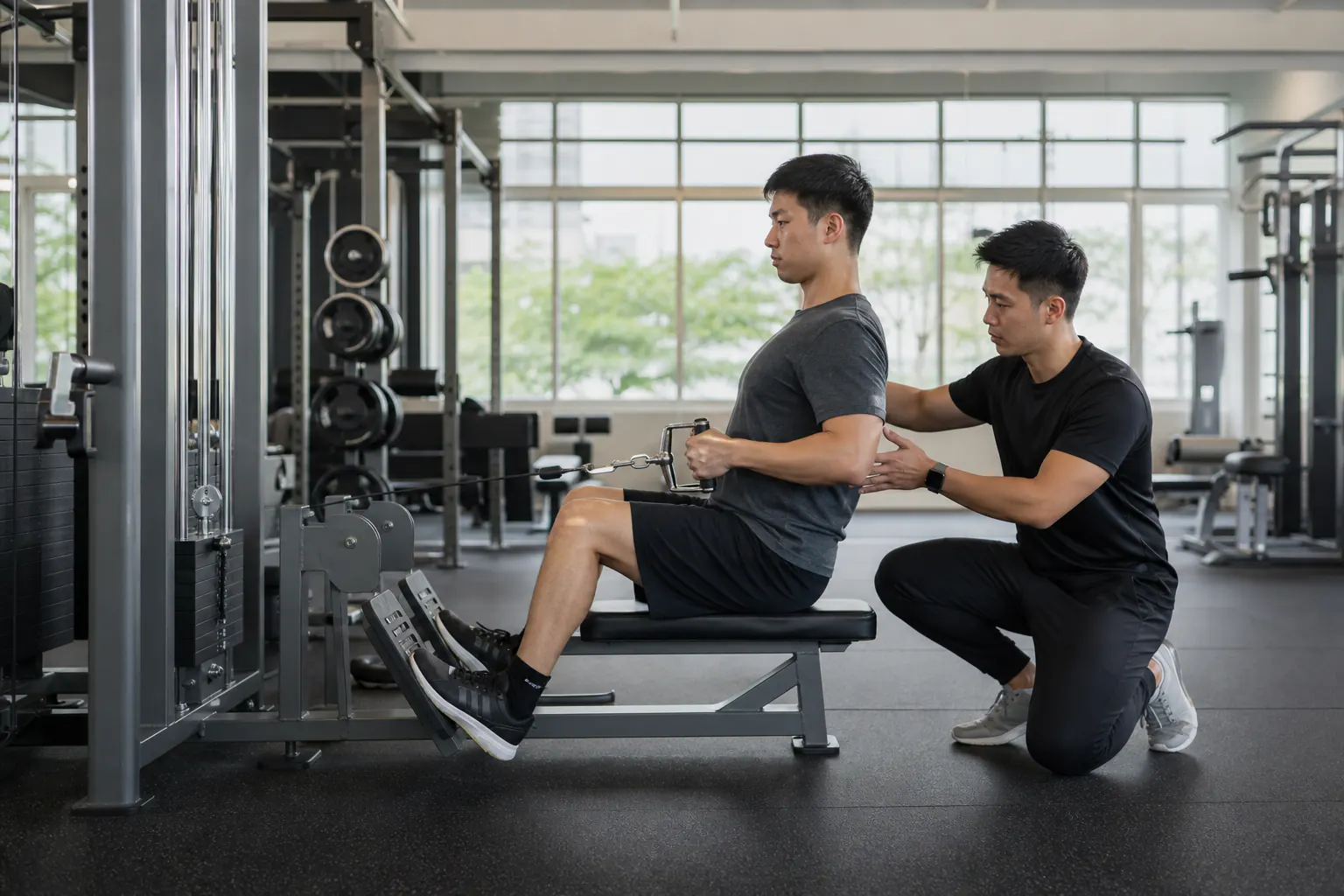
Use tempo training to maximise muscle growth by controlling each phase of every rep. Covers tempo prescriptions, exercises, and programming for hypertrophy.
Watch the average gym-goer perform a set of bicep curls. They yank the weight up in half a second, let it drop in another half second, and repeat ten times. Total time under tension for the set: about ten seconds. For a muscle that needs a minimum of 30-40 seconds under tension per set to maximise hypertrophy, they are leaving growth on the table with every rep.
Tempo training prescribes specific speeds for each phase of an exercise - the lowering, the pause at the bottom, the lifting, and the pause at the top. Controlling tempo increases time under tension, improves mind-muscle connection, and forces you to use weights your muscles can actually handle rather than weights your momentum can move.
How to Read a Tempo Prescription
Tempo is written as a four-digit number, like 3-1-2-0. Each number represents the time in seconds for one phase of the repetition:
- First number: Eccentric (lowering) phase
- Second number: Pause at the bottom (stretched position)
- Third number: Concentric (lifting) phase
- Fourth number: Pause at the top (contracted position)
So a bench press at 3-1-2-0 means:
- Lower the bar to your chest over 3 seconds
- Pause at the bottom for 1 second
- Press the bar up over 2 seconds
- No pause at the top - immediately begin the next rep
A single rep takes 6 seconds. A set of 8 reps takes 48 seconds. Compare that to an uncontrolled set of 8 where each rep takes 2 seconds - that is only 16 seconds of tension. Three times less stimulus from the same number of reps.
Why Tempo Matters for Hypertrophy
Time Under Tension
Research suggests that sets lasting 30-60 seconds produce the best hypertrophy stimulus. Sets that are too short (under 20 seconds) do not create enough metabolic stress. Sets that are too long (over 70 seconds) require such light weights that mechanical tension is insufficient.
Tempo prescriptions let you precisely control set duration to hit this 30-60 second window regardless of the rep range.
Elimination of Momentum
Without tempo control, most people cheat. They swing dumbbells on curls, bounce the bar on bench press, and use the stretch reflex to explode out of squats. All of these momentum-assisted techniques reduce the actual work the target muscle performs.
Prescribed tempos eliminate cheating. A 3-second eccentric on a dumbbell curl prevents swinging. A 1-second pause on a bench press prevents bouncing. The muscle does all the work.
Enhanced Mind-Muscle Connection
Slower movements allow you to focus on feeling the target muscle work. A 4-second lowering phase on a lat pulldown gives you time to feel your lats stretching and controlling the weight. A half-second lowering phase does not give you time to feel anything.
This mind-muscle connection is not just a feeling - research by Schoenfeld and Contreras showed that focusing on the target muscle during an exercise increases EMG activity in that muscle by 20-30 percent.
Effective Tempo Prescriptions for Different Goals
Hypertrophy Focus: 3-1-2-0
- 3-second eccentric, 1-second pause at the stretch, 2-second concentric
- Each rep takes 6 seconds
- 8 reps = 48 seconds (within the ideal time under tension window)
- Best for: most isolation and compound exercises when hypertrophy is the goal
Eccentric Emphasis: 4-0-1-0
- 4-second eccentric, no pause, 1-second concentric
- Emphasises the lowering phase, which research shows produces greater muscle damage and growth
- Best for: exercises where you want to build eccentric strength (pull-ups, RDLs, hamstring curls)
Paused Reps: 2-2-1-1
- 2-second eccentric, 2-second pause at the stretch, 1-second concentric, 1-second pause at contraction
- Eliminates the stretch reflex and forces full muscular contraction from a dead stop
- Best for: squat variations, bench press, and exercises where you want to build bottom-position strength
Controlled Standard: 2-0-1-0
- 2-second eccentric, no pause, 1-second concentric
- Slightly slower than uncontrolled but not excessively slow
- Good as a default tempo for most training when you do not want to overthink it
Tempo Training for Specific Exercises
Bench Press (3-1-2-0)
Lower the bar over 3 seconds. Touch and hold for 1 second. Press over 2 seconds. No pause at the top.
At a 3-1-2-0 tempo, you will need to reduce your normal bench weight by 15-20 percent. If you normally bench 70kg for 10, use 55-60kg with this tempo. The set will be harder despite the lighter weight.
Dumbbell Romanian Deadlift (4-1-2-1)
Lower over 4 seconds - feel the stretch developing in your hamstrings with every centimetre of descent. Hold the stretched position for 1 second. Rise over 2 seconds. Squeeze your glutes at the top for 1 second.
This tempo on RDLs is transformative for hamstring development. A set of 8 takes 64 seconds. Your hamstrings will be screaming.
Lat Pulldown (3-1-2-1)
Lower the weight over 3 seconds - resist the stack pulling your arms up. Pause at the stretch for 1 second with arms fully extended. Pull down over 2 seconds. Squeeze your lats at the bottom for 1 second.
The squeeze at the bottom is critical for lat development. Most people let the weight fly back up immediately. That 1-second contraction hold makes an enormous difference in how the lats develop.
Leg Extension (3-2-2-1)
Lower the weight over 3 seconds - your quads control the descent. Pause at the bottom for 2 seconds - the hardest part, as your quads want to drop the weight. Extend over 2 seconds. Hold the contraction at the top for 1 second.
A 3-2-2-1 tempo on leg extensions with a moderate weight produces more quad soreness than heavy squats for most people. The sustained tension is a completely different stimulus.
Programming Tempo Training Into Your Routine
Option 1: Tempo Phase (4-6 Weeks)
Dedicate a training phase to tempo work. Use prescribed tempos for all exercises. Reduce weights by 15-25 percent across the board. Focus on perfect execution.
After the tempo phase, return to normal tempos with your previous weights. They will feel lighter because your muscles have been forced to work harder for the previous 4-6 weeks.
Option 2: Tempo on Isolation Exercises Only
Keep your compound movements at normal tempo (focus on moving heavy weight with good form) and use slow tempos for isolation work (where muscle development, not strength, is the goal).
Example push day:
- Bench press: normal tempo, 4 x 6 heavy
- Incline dumbbell press: 3-1-2-0, 3 x 10
- Cable flye: 3-1-2-1, 3 x 12
- Lateral raise: 3-0-2-1, 3 x 15
Option 3: Eccentric Emphasis Sessions
One session per week uses extended eccentric tempos (4-5 second lowering phases) on all exercises. This creates significant muscle damage, which is one of the three primary mechanisms of muscle growth.
Warning: eccentric-heavy sessions cause more delayed-onset muscle soreness (DOMS) than normal training. Do not do this the day before a session for the same muscle group.
Common Tempo Training Mistakes
Counting Too Fast
A "3-second" eccentric that actually takes 1.5 seconds is not tempo training - it is normal training with bad counting. Use a metronome app on your phone (free apps available on all platforms) or count "one thousand one, one thousand two, one thousand three" in your head.
Using Normal Weights
If you use your regular working weight with a prescribed tempo, you will fail well before your target reps. Reduce weight by 15-25 percent when adding tempo. The ego adjustment is temporary.
Applying Tempo to Every Exercise, Every Session
Tempo training is a tool, not a religion. Some exercises and some training goals are better served by explosive, fast-tempo lifting. Heavy squats, Olympic lifts, and plyometrics should be performed with maximal speed. Reserve prescribed tempos for hypertrophy-focused work.
The Simple Takeaway
If you are training for muscle size and you are not controlling your rep tempo, you are probably leaving gains on the table. A 3-1-2-0 tempo on most exercises will immediately improve the quality of your sets, reduce the weight you need to use, and increase the hypertrophy stimulus per rep.
Try it for one training block. Film yourself to verify your actual tempo matches your intended tempo. Be honest about the count. Your muscles do not care about the number on the dumbbell - they care about how long they are under tension and how hard they are working. Tempo training maximises both.
Part of our comprehensive guide:
The Complete Guide to Personal Training Methods in Malaysia→Also in this series:
Related Articles
Find a Personal Trainer
Ready to put this into practice? Connect with a certified personal trainer near you, or explore by service and goal.