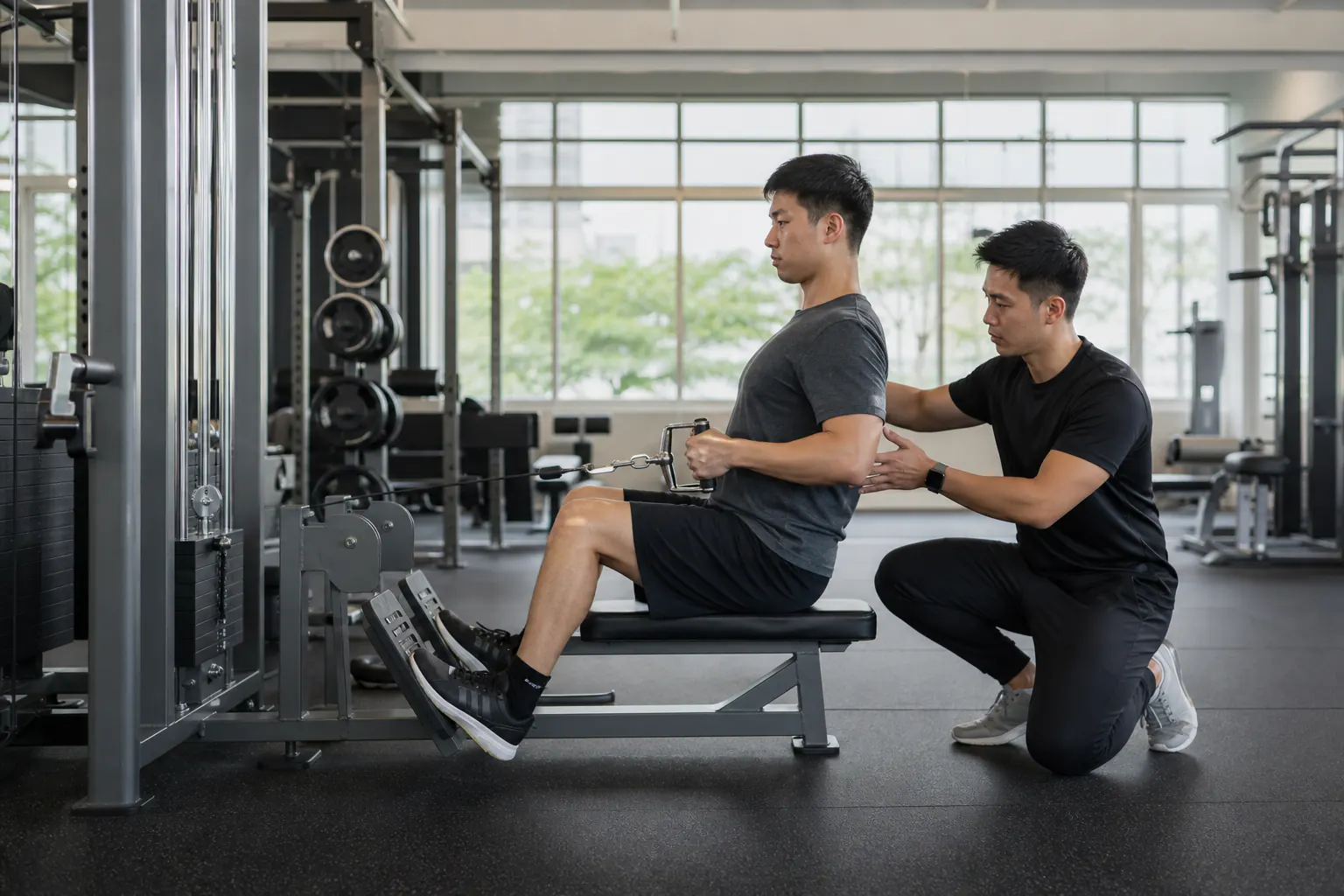
A detailed comparison of lat pulldowns and pull-ups for back development. Which exercise is better for Malaysian lifters at every experience level?
The lat pulldown and the pull-up train the same primary muscles - the latissimus dorsi, biceps, and rear deltoids. But they are not identical exercises, and understanding their differences helps you programme them more effectively.
The Pull-Up Advantage
Pull-ups are a closed-chain exercise. Your body moves through space while your hands remain fixed on the bar. This recruits more stabiliser muscles, demands greater core engagement, and builds functional upper body strength that transfers to real-world activities.
Pull-ups also impose a natural load progression. Your bodyweight is the resistance. For a 75kg Malaysian male, every rep is a 75kg pull. There is no way to cheat the load - you either move your body or you do not.
Benefits of pull-ups:
- Greater core activation and stabiliser recruitment
- Superior grip strength development
- No equipment needed beyond a bar
- Better carryover to athletic movements
- Builds relative strength effectively
The Lat Pulldown Advantage
Lat pulldowns are an open-chain exercise performed on a cable machine. You remain seated while the load moves toward you. This allows precise load selection and makes the exercise accessible to beginners who cannot yet perform a bodyweight pull-up.
Benefits of lat pulldowns:
- Adjustable resistance from light to very heavy
- Accessible to beginners and overweight individuals
- Easier to isolate the lats with controlled tempo
- Multiple grip attachments allow training from different angles
- Safer for those with shoulder mobility limitations
Head-to-Head Comparison
Muscle Activation
Research from the Journal of Strength and Conditioning shows that pull-ups produce slightly higher lat activation than pulldowns at equivalent relative loads. However, the difference is modest - approximately 5-10%. Both exercises effectively target the back musculature.
Strength Development
Pull-ups build relative strength. Pulldowns build absolute strength. If your goal is to move your own body efficiently, prioritise pull-ups. If your goal is maximum back hypertrophy, pulldowns offer more flexibility in loading.
Progression
Pull-ups progress through assisted variations (band-assisted, machine-assisted) to bodyweight to weighted pull-ups. This progression is linear but has large jumps - adding even 2.5kg to a pull-up is a significant increase.
Pulldowns progress in 2.5-5kg increments on the weight stack, allowing smoother progression. This makes them superior for beginners working toward their first pull-up.
Programming Recommendations
For beginners (cannot do 5 pull-ups): Start with lat pulldowns at a challenging weight for 3 sets of 8-12. Simultaneously work on assisted pull-ups or negatives. Once you can do 5 clean pull-ups, transition to making pull-ups your primary back exercise.
For intermediate lifters (5-12 pull-ups): Use pull-ups as your main vertical pull. Follow with lat pulldowns as a secondary exercise using different grips - wide, close, neutral - for additional volume.
For advanced lifters (12+ pull-ups): Weighted pull-ups for strength. Lat pulldowns with slow eccentrics for hypertrophy. Both exercises have a place in a well-designed programme.
The Malaysian Gym Context
Most commercial gyms in Malaysia - Anytime Fitness, Celebrity Fitness, CHi Fitness - have multiple lat pulldown stations and at least one pull-up bar. Use both. The pull-up bar is often less crowded during peak hours because fewer people can actually use it. That is an opportunity, not an obstacle.
If you train at a condo gym with limited equipment, a doorframe pull-up bar (RM40-80 on Shopee) is one of the best investments you can make. It gives you access to the single most effective bodyweight back exercise available.
The bottom line: pull-ups are the superior exercise for overall back development, but lat pulldowns are an excellent complement and a necessary stepping stone for those building toward their first pull-up. Use both strategically, and your back will grow.
Part of our comprehensive guide:
The Complete Guide to Personal Training Methods in Malaysia→Also in this series:
Related Articles
Find a Personal Trainer
Ready to put this into practice? Connect with a certified personal trainer near you, or explore by service and goal.