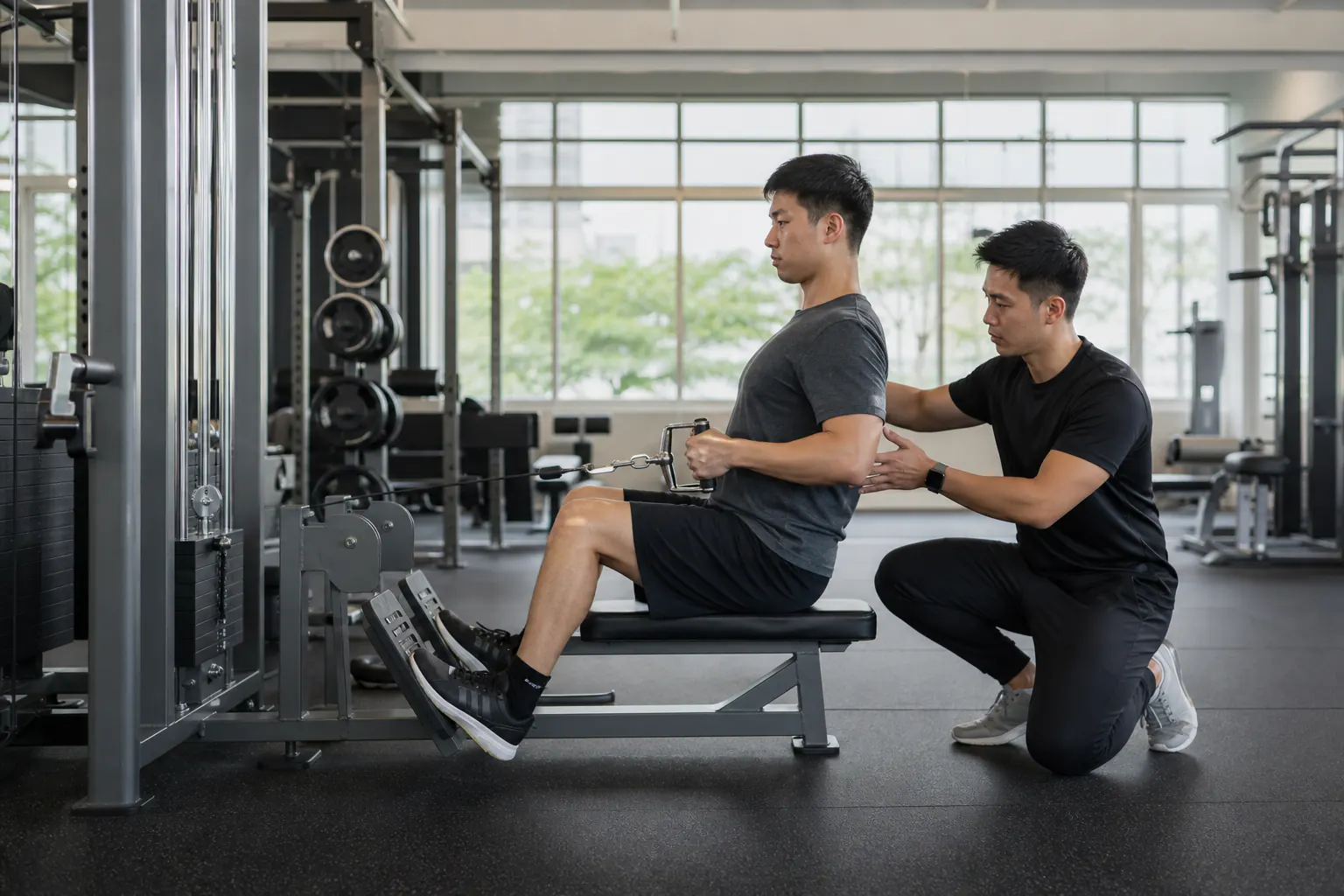
Core stability vs core strength - they're not the same thing. Learn the difference, why both matter, and how to train each for better performance.
Most people use "core strength" and "core stability" interchangeably. They're not the same thing, and confusing them leads to suboptimal training. A strongman who can deadlift 300kg has phenomenal core strength. A gymnast who can hold an iron cross has incredible core stability. These are different qualities trained in different ways.
Understanding the distinction will change how you train your core - and probably save you from wasting time on exercises that don't address your actual weaknesses.
Core Strength: Moving Against Resistance
Core strength is your core muscles' ability to generate force - to produce movement or resist external forces dynamically. Think of exercises where your spine moves:
- Crunches and sit-ups (spinal flexion)
- Cable woodchops (rotation)
- Back extensions (spinal extension)
- Hanging leg raises (hip flexion with core engagement)
These exercises involve your core muscles actively shortening or lengthening under load. Your rectus abdominis, obliques, and erectors are doing work through a range of motion.
When core strength matters: Any activity requiring trunk movement under load. Throwing a ball, swinging a golf club, getting up from the floor, lifting a heavy box off a shelf.
Core Stability: Resisting Unwanted Movement
Core stability is your core muscles' ability to prevent unwanted movement of the spine while your limbs move. It's about maintaining a rigid, neutral torso while forces try to move it.
Think of exercises where your spine stays still despite external forces:
- Planks (anti-extension - resisting the urge to sag)
- Pallof press (anti-rotation - resisting a cable pulling you sideways)
- Dead bug (anti-extension while limbs move)
- Farmer's walk (anti-lateral flexion - resisting being pulled sideways by weight)
- Bird dog (anti-rotation and extension while moving limbs)
When core stability matters: Almost every compound exercise in the gym. During a heavy squat, your core's job isn't to move - it's to prevent your spine from buckling. During a deadlift, your core stabilises your spine against the massive load trying to flex it. During an overhead press, your core prevents your lower back from hyperextending.
Why Most People Train the Wrong One
Walk into any gym in Malaysia and observe how people train abs. They're doing crunches, sit-ups, Russian twists, and maybe some hanging leg raises. These are all core strength exercises - dynamic movements that flex, extend, or rotate the spine.
Meanwhile, the exercises most people need - the stability exercises - are ignored because they look boring. Planks, Pallof presses, and dead bugs aren't Instagram-worthy. But for anyone who lifts weights, plays sports, or wants to protect their back, core stability is arguably more important than core strength.
Consider this: when has your spine ever needed to violently flex forward in real life or sport? Almost never. But when has your spine needed to stay rigid while an external force tries to move it? Every time you pick something up, carry something, push something, or play any sport.
The Core Stability Exercises You Should Be Doing
Anti-Extension Exercises
These train your core to resist extension (lower back arching).
Plank: The foundation. Hold for quality, not just time. If you can hold a plank for 60+ seconds easily, you need harder variations - not longer holds.
Ab Wheel Rollout: Far more challenging than a plank. Start from your knees. Roll out as far as you can control, then pull back. 3 sets of 8-12 reps.
Dead Bug: Lie on your back. Press your lower back into the floor. Extend opposite arm and leg slowly while maintaining that lower back position. 3 sets of 8 per side.
Body Saw: In a plank position on sliders or a towel on smooth flooring. Push your body backward and forward while maintaining plank position. 3 sets of 10.
Anti-Rotation Exercises
These train your core to resist rotation.
Pallof Press: Stand sideways to a cable machine. Hold the handle at your chest with both hands. Press the handle straight forward, resisting the cable's pull. Hold for 2-3 seconds. Return. 3 sets of 10 per side.
Single-Arm Farmer's Walk: Carry a heavy dumbbell in one hand and walk. Your core has to resist the side bend. 3 sets of 30-40 metres per side.
Renegade Row: In push-up position with hands on dumbbells. Row one dumbbell up while maintaining a stable plank. 3 sets of 8 per side.
Bird Dog: On all fours, extend opposite arm and leg. Hold for 3 seconds. Return. 3 sets of 10 per side.
Anti-Lateral Flexion Exercises
These train your core to resist side bending.
Suitcase Carry: Like a farmer's walk but one side only. Carry a heavy dumbbell or kettlebell in one hand, walk upright without leaning. 3 sets of 30-40 metres per side.
Side Plank: Hold your body in a straight line on one forearm and the side of your foot. 3 sets of 30-45 seconds per side.
Single-Arm Overhead Press: Pressing a dumbbell overhead with one arm requires significant anti-lateral flexion to keep your torso upright.
A Balanced Core Training Programme
Twice Per Week, 10-15 Minutes
Session A:
- Dead Bug - 3 x 8/side (anti-extension)
- Pallof Press - 3 x 10/side (anti-rotation)
- Side Plank - 3 x 30 sec/side (anti-lateral flexion)
Session B:
- Ab Wheel Rollout - 3 x 8-12 (anti-extension)
- Single-Arm Farmer's Walk - 3 x 30m/side (anti-rotation + anti-lateral flexion)
- Hanging Knee Raise - 3 x 10-15 (core strength - hip flexion)
This covers all core functions in about 10-15 minutes. Do it at the end of your regular training session or on rest days.
How Core Stability Improves Your Main Lifts
Squat
A stable core keeps your torso upright during heavy squats. Without it, your chest drops forward, your lower back rounds, and the weight collapses you. Training anti-extension (planks, ab wheel) directly improves your squat torso position.
Deadlift
Your core's job during a deadlift is to keep your spine neutral against the enormous load trying to flex it. Core stability training - not crunches - prepares your core for this demand.
Bench Press
The arch in bench press requires core stability to maintain. Your core has to brace your entire body into the bench while your arms press. A weak core means a loose setup and less force transfer.
Overhead Press
Standing overhead press is as much a core exercise as it is a shoulder exercise. Your core prevents hyperextension as the weight goes overhead. Heavy Pallof presses and single-arm overhead work build this stability.
The Bottom Line
Stop doing 100 crunches and calling it core training. Start training your core's primary function - stabilisation. Add anti-extension, anti-rotation, and anti-lateral flexion exercises to your programme. Your lifts will get stronger, your back will hurt less, and your core will actually be functional - not just visible on a lean frame.
Six-pack abs are made in the kitchen (calorie deficit) and revealed through low body fat. Core function is built through stability training. Don't confuse the two.
Part of our comprehensive guide:
The Complete Guide to Personal Training Methods in Malaysia→Also in this series:
Related Articles
Find a Personal Trainer
Ready to put this into practice? Connect with a certified personal trainer near you, or explore by service and goal.