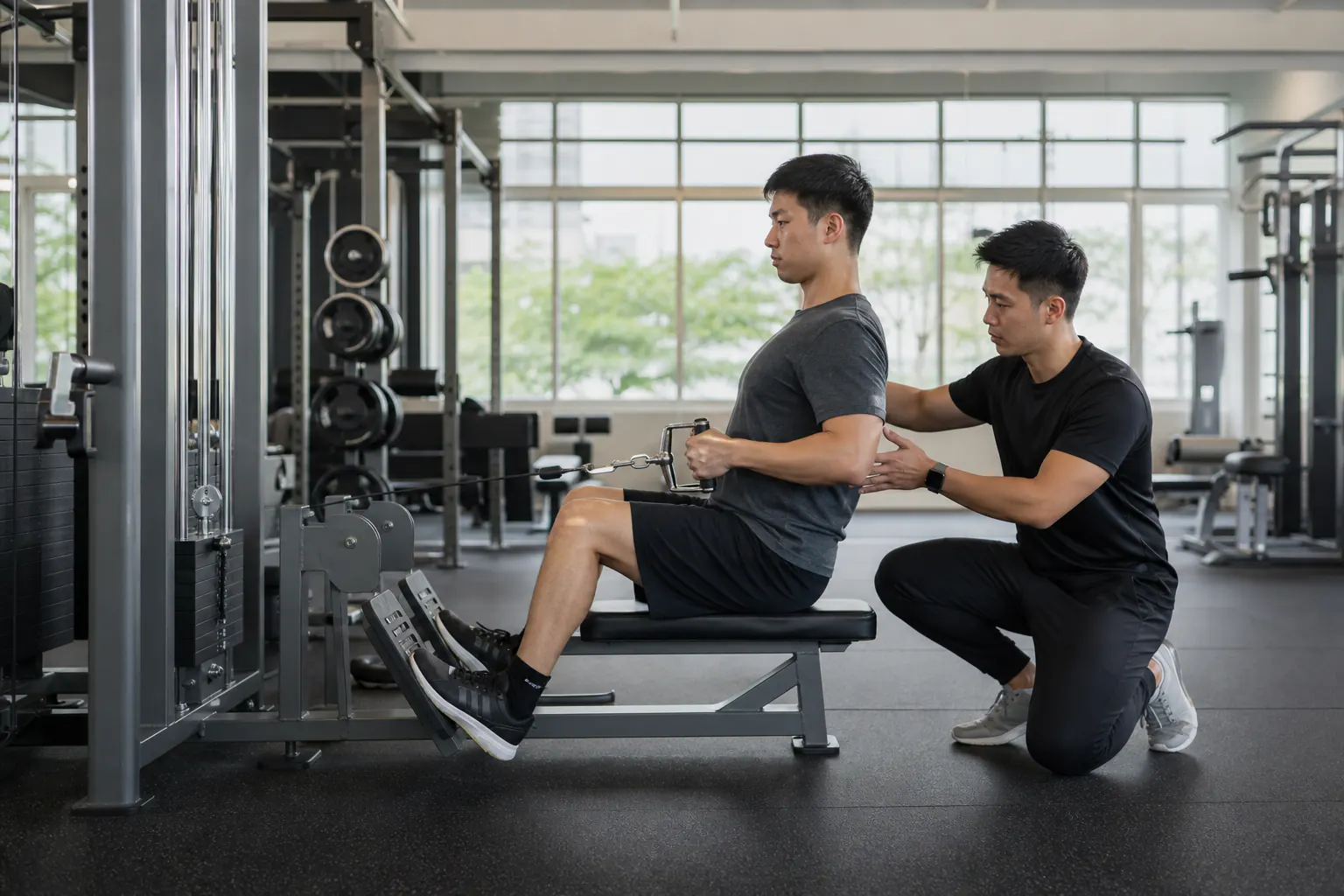
The best posterior chain exercises for strength and muscle. Covers deadlifts, hip hinges, glute work, and programming for a complete backside.
Most gym-goers in Malaysia train what they see in the mirror - chest, shoulders, arms, and maybe quads. The entire back side of the body gets neglected. Then they wonder why their posture is terrible, their lower back hurts at the office desk, and their squat and deadlift numbers stall.
The posterior chain - everything from the base of your skull to your heels along the back of your body - is the engine of athletic performance and the foundation of a healthy spine. Weak posterior chain muscles are behind most lower back pain cases I see in clients, and strengthening them is usually the fix.
What Muscles Make Up the Posterior Chain?
From top to bottom:
- Trapezius and rhomboids (upper back)
- Erector spinae (muscles running alongside the spine)
- Latissimus dorsi (lats)
- Gluteus maximus, medius, and minimus (glutes)
- Hamstrings (biceps femoris, semitendinosus, semimembranosus)
- Gastrocnemius and soleus (calves)
These muscles work together as a chain - not in isolation. When you pick something heavy off the floor, your calves stabilise your ankles, your hamstrings and glutes extend your hips, your erectors keep your spine rigid, and your traps and lats hold your shoulder blades in position. One weak link compromises the entire chain.
The Big Posterior Chain Exercises
1. Conventional Deadlift
The king of posterior chain exercises. No single movement loads more of your backside simultaneously than a heavy deadlift.
Setup: Feet hip width apart, bar over mid-foot, grip just outside your legs. Push the floor away with your legs while keeping your chest up and the bar close to your body.
Programming: 4 sets of 5 at 75-80% of your max. Heavy enough to challenge the posterior chain, light enough for good form over multiple reps.
2. Romanian Deadlift (RDL)
If the deadlift is the king, the RDL is the prime minister. It isolates the hip hinge pattern and hammers the hamstrings and glutes through a long range of motion.
Setup: Start from the top (standing with the bar). Push your hips back while keeping the bar close to your legs. Lower until you feel a deep stretch in your hamstrings - typically when the bar reaches mid-shin. Drive your hips forward to return.
Key detail: The RDL is a hip hinge, not a squat. Your knees should bend only slightly - about 15-20 degrees. If you are bending your knees a lot, you are squatting the weight, not hinging.
Programming: 3-4 sets of 8-10 reps. Use about 60-70% of your deadlift max.
3. Hip Thrust
The hip thrust is the most effective glute isolation exercise available. Research by Bret Contreras - who built his career around glute training - shows the hip thrust activates the gluteus maximus to a greater degree than squats or deadlifts.
Setup: Upper back on a bench, barbell across your hips (use a pad or towel for comfort). Feet flat on the floor, about shoulder width apart. Drive through your heels, squeeze your glutes at the top, and hold for 1 second.
Programming: 4 sets of 10-12. Start at 40-60kg and progress from there. Many women I coach in KL hip thrust well above their body weight within 6 months of consistent training.
4. Good Morning
An old-school lift that fell out of fashion but is making a comeback. Place a barbell across your upper back (like a squat) and hinge at the hips until your torso is roughly parallel to the floor. Keep your knees slightly bent and your back flat throughout.
Warning: Start very light - just the bar - and master the movement before adding weight. A 20kg good morning with perfect form is more valuable than a 60kg good morning with a rounded back.
Programming: 3 sets of 8-10 with moderate weight. This is an accessory, not a maximal lift.
5. Glute-Ham Raise (GHR)
If your gym has a GHR machine (some Anytime Fitness and hardcore gyms in Malaysia do), this is one of the best hamstring exercises available. It trains the hamstrings through both knee flexion and hip extension simultaneously - the only exercise that does this effectively.
Setup: Lock your feet into the machine, start with your body parallel to the floor, and lower your torso toward the ground by extending at the knee. Pull yourself back up using your hamstrings.
Most people cannot do a single full GHR at first. Start with negatives - lower yourself over 5 seconds, then push off the floor to get back up. Work toward full reps over 4-6 weeks.
Programming: 3-4 sets of 5-8 reps. If full reps are too hard, do 4 sets of 3-5 second negatives.
6. Back Extension (Hyperextension)
Simple, effective, and available in almost every gym. Lock your thighs against the pad, cross your arms or hold a plate against your chest, and hinge at the hips to lower your torso. Extend back to a straight body position - do not hyperextend past neutral.
Programming: 3 sets of 12-15. Add weight by holding a 5-10kg plate once bodyweight becomes easy.
7. Pull-Up
While primarily an upper back exercise, the pull-up heavily involves the lats, which are a key posterior chain muscle. Full-range pull-ups - from a dead hang to chin over the bar - also require significant core and lower back engagement to prevent swinging.
Programming: 4 sets to near failure. If you cannot do pull-ups, use band assistance or do lat pulldowns with the same movement pattern.
A Complete Posterior Chain Training Session
Here is a session I use with intermediate lifters:
- Conventional deadlift: 4 sets of 5 at 77.5%
- Romanian deadlift: 3 sets of 10
- Hip thrust: 4 sets of 10
- Back extension with plate: 3 sets of 12
- Face pull: 3 sets of 15
This session takes about 50-60 minutes and covers the posterior chain from top to bottom. Run it once per week alongside your other training days.
How Posterior Chain Work Fixes Lower Back Pain
The majority of non-specific lower back pain in Malaysian office workers comes from two things: tight hip flexors (from sitting all day) and weak glutes and spinal erectors (from not training them).
When your glutes are weak, your lower back compensates by working harder during movements like bending, lifting, and even walking. Over months and years, this compensation leads to chronic fatigue and pain in the lumbar region.
Strengthening the glutes and hamstrings offloads the lower back. Hip thrusts, RDLs, and glute bridges teach the glutes to fire properly during hip extension, taking pressure off the spinal erectors.
Most clients I work with who have non-specific lower back pain report significant improvement within 6-8 weeks of consistent posterior chain training. Not from stretching, not from massage (though both help temporarily), but from actually strengthening the muscles that support the spine.
Posterior Chain Training for Desk Workers
If you work a typical 9-to-5 office job in Cyberjaya, KL Sentral, or anywhere else in Malaysia, your posterior chain is probably deconditioned from hours of sitting. A minimum effective dose for maintaining posterior chain health:
- Hip thrusts or glute bridges: 3 sets of 15, three times per week
- Romanian deadlifts: 3 sets of 10, twice per week
- Face pulls or band pull-aparts: 3 sets of 15, daily
This takes about 15-20 minutes per session and can be done at home with a pair of dumbbells. The investment is small. The return - less back pain, better posture, and a foundation for heavier training if you choose - is significant.
Programming Posterior Chain Work Into a Full Training Week
Push-Pull-Legs Split
- Pull day: Deadlift, barbell row, RDL, face pulls, bicep curls
- Leg day: Squat, hip thrust, leg curl, back extension, calf raises
Upper-Lower Split
- Lower day 1: Squat-focused + hip thrust + leg curl
- Lower day 2: Deadlift-focused + RDL + back extension
Full Body (3 Days Per Week)
- Day 1: Deadlift + push exercise + pull exercise
- Day 2: Squat + hip thrust + upper body work
- Day 3: RDL + push exercise + pull exercise
The posterior chain should get at least 2 dedicated training sessions per week, with a total weekly volume of 15-20 working sets across all posterior chain muscles. More than that is fine if you recover from it. Less than that, and you are leaving strength and muscle on the table.
Train your backside as hard as you train your front. Your back, your posture, and your performance will all improve.
Part of our comprehensive guide:
The Complete Guide to Personal Training Methods in Malaysia→Also in this series:
Related Articles
Find a Personal Trainer
Ready to put this into practice? Connect with a certified personal trainer near you, or explore by service and goal.