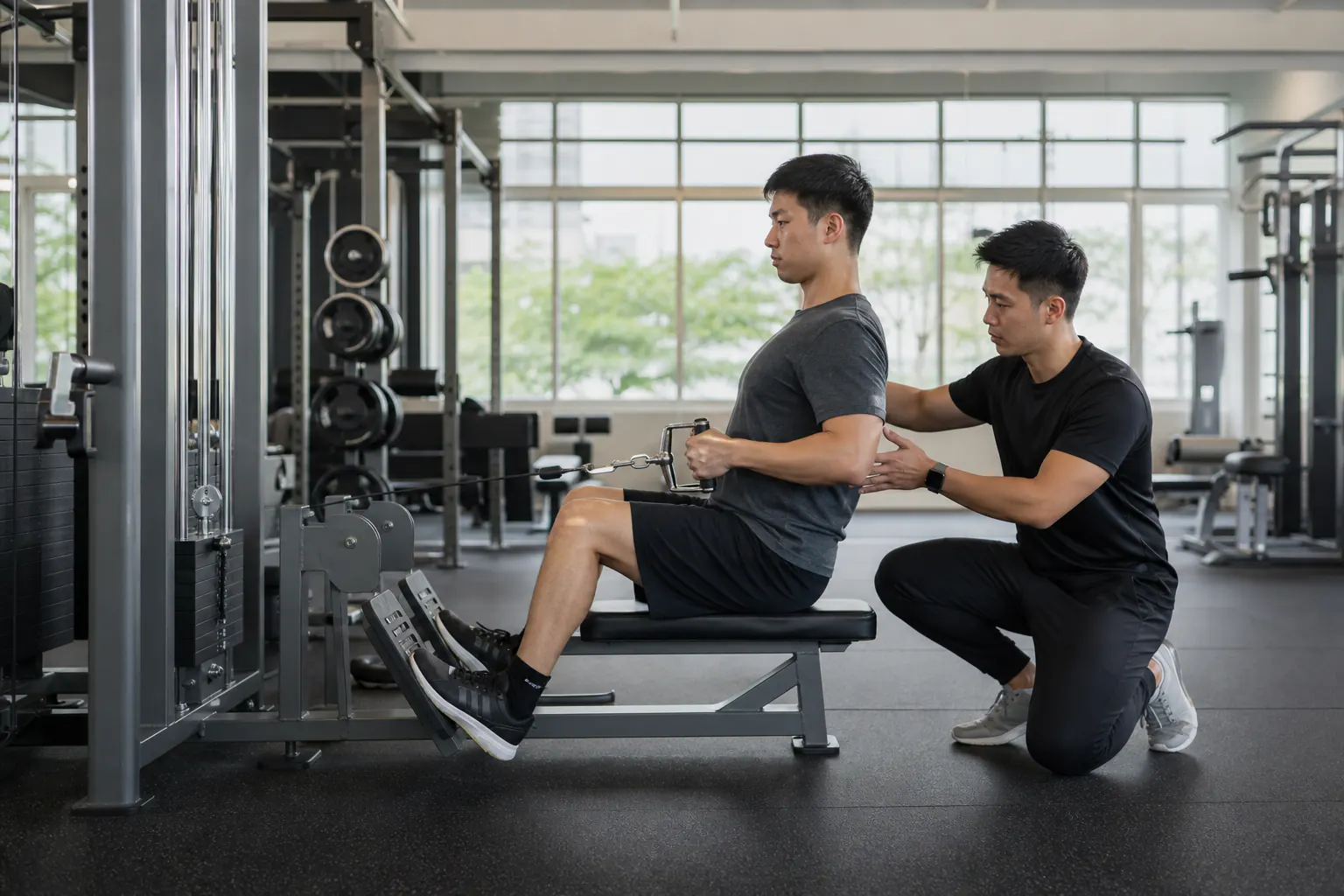
Estimate your one rep max using proven formulas. When to test, how to test safely, and why your estimated 1RM matters for programming.
Your one rep max (1RM) is the heaviest weight you can lift for one complete rep with proper form. It is the single most important number for programme design - training percentages, progressive overload targets, and strength standards all reference your 1RM.
But actually testing a true 1RM carries injury risk, requires significant warm-up time, and creates substantial fatigue that affects subsequent training. For most gym-goers, estimating your 1RM from submaximal work is safer and more practical.
The Epley Formula (Most Popular)
1RM = Weight × (1 + Reps / 30)
If you bench press 80 kg for 6 reps: 1RM = 80 × (1 + 6/30) = 80 × 1.2 = 96 kg
The Brzycki Formula (More Conservative)
1RM = Weight × (36 / (37 - Reps))
Same example: 80 kg for 6 reps: 1RM = 80 × (36 / 31) = 80 × 1.161 = 93 kg
Quick Reference Table
| Reps Performed | Approximate % of 1RM |
|---|---|
| 1 | 100% |
| 2 | 95% |
| 3 | 93% |
| 4 | 90% |
| 5 | 87% |
| 6 | 85% |
| 7 | 83% |
| 8 | 80% |
| 10 | 75% |
| 12 | 70% |
| 15 | 65% |
How to Use Your Estimated 1RM
Percentage-based programming prescribes weights as percentages of your 1RM:
- 85-95% - strength sets (1-5 reps)
- 70-85% - hypertrophy sets (6-12 reps)
- 60-70% - endurance/technique sets (12-20 reps)
If your estimated bench press 1RM is 100 kg, your hypertrophy work at 75% would use 75 kg for sets of 8-10.
When to Test a True 1RM
Before a competition. Powerlifters and strength athletes need accurate maxes for attempt selection.
Every 8-12 weeks during a strength-focused block, if you enjoy testing and can do so safely.
With a spotter. Never attempt a true 1RM on bench press, squat, or overhead press alone. Have a competent spotter or use safety pins set at appropriate height.
Testing Protocol
- Warm up thoroughly - 5 minutes of cardio, then progressive warm-up sets:
- Bar × 10 - 40% × 8 - 60% × 5 - 75% × 3 - 85% × 1 - 90% × 1
- Rest 3-5 minutes between attempts above 85%
- Attempt your estimated 1RM
- If successful, add 2.5-5 kg and attempt again after 5 minutes rest
- When you fail a rep, your previous successful lift was your 1RM
Accuracy Considerations
Formulas become less accurate above 10 reps. A 10-rep set gives a reasonable estimate. A 20-rep set is too far from maximal effort for reliable 1RM prediction.
Individual variation matters. Some lifters are better at low reps (neurally efficient), while others perform better at higher reps (muscular endurance dominant). Your estimated 1RM from 5 reps may differ from your estimate at 10 reps.
Use formulas as guidelines, not gospel. An estimated 1RM of 100 kg means your true max is probably between 95-105 kg. Programme accordingly with some flexibility.
Strength Standards for Malaysian Lifters
These are approximate benchmarks based on bodyweight ratios for recreational lifters:
Male (intermediate, after 1-2 years of training):
- Bench press: 1.0-1.25 × bodyweight
- Squat: 1.25-1.5 × bodyweight
- Deadlift: 1.5-2.0 × bodyweight
Female (intermediate, after 1-2 years of training):
- Bench press: 0.6-0.75 × bodyweight
- Squat: 1.0-1.25 × bodyweight
- Deadlift: 1.25-1.5 × bodyweight
These are not elite standards - they are achievable milestones for any dedicated lifter with good coaching and consistent training.
Part of our comprehensive guide:
The Complete Guide to Personal Training Methods in Malaysia→Also in this series:
Related Articles
Find a Personal Trainer
Ready to put this into practice? Connect with a certified personal trainer near you, or explore by service and goal.