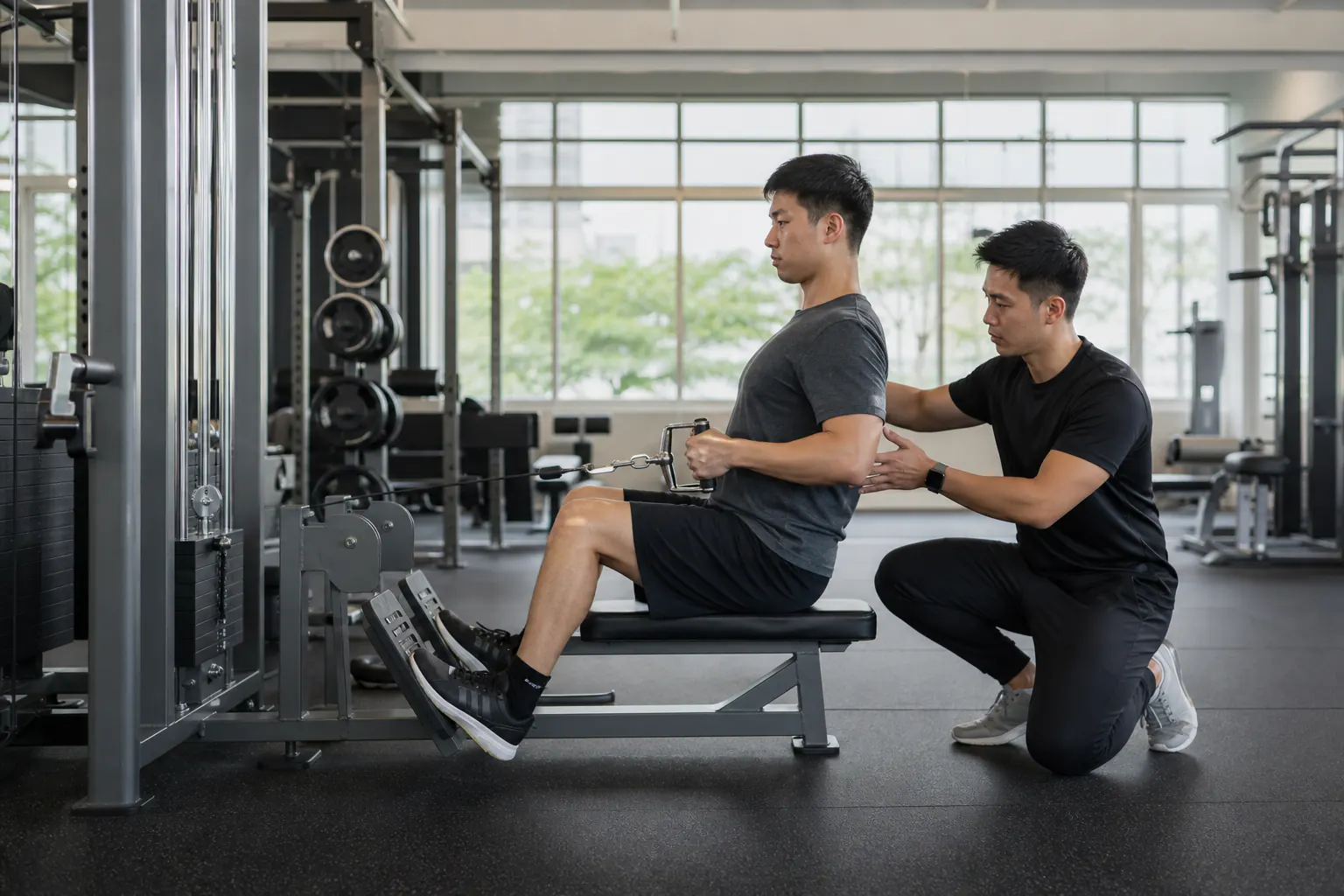
Face pulls strengthen your rotator cuff and fix shoulder imbalances. Learn proper form, sets, reps, and programming from a Malaysian coach.
If I could add one exercise to every gym-goer's programme, it would be face pulls. Not squats. Not deadlifts. Face pulls.
Why? Because the modern lifestyle - sitting hunched over desks, driving, scrolling phones - combined with a gym programme heavy on pressing (bench press, overhead press, push-ups) creates a shoulder imbalance that eventually leads to pain, impingement, and injury. Face pulls directly counteract this imbalance by strengthening the rear deltoids, external rotators, and scapular stabilisers that keep your shoulders healthy.
I've seen hundreds of shoulder injuries in my coaching career. The overwhelming majority could have been prevented with regular face pulls and external rotation work.
Why Your Shoulders Need Face Pulls
The Imbalance Problem
Most gym programmes include far more pushing than pulling, and almost no external rotation work. A typical week:
- Bench press (internal rotation, forward push)
- Overhead press (forward push)
- Push-ups (internal rotation, forward push)
- Lateral raises (maybe)
- Rows (if they remember)
- Rear delt work (almost never)
The result: your front delts and internal rotators become dominant, pulling your shoulders forward into a rounded position. Your rear delts and external rotators become weak and overstretched. Over time, this creates:
- Shoulder impingement (pain when lifting arms overhead)
- Rotator cuff strain
- Reduced bench press performance (unstable shoulder = less force)
- Rounded posture
- Neck and upper back pain
How Face Pulls Fix This
Face pulls train three critical functions simultaneously:
- Rear deltoid activation - pulls the shoulders back, counteracting the forward pull of the front delts
- External rotation - strengthens the infraspinatus and teres minor (two of the four rotator cuff muscles)
- Scapular retraction - trains the rhomboids and mid-traps to pull the shoulder blades together
No other single exercise hits all three as effectively.
How to Perform Face Pulls Correctly
Setup
- Attach a rope handle to a cable machine at upper chest or face height
- Grip the rope with thumbs pointing toward you (not the standard overhand grip)
- Step back until the cable is taut with your arms extended
- Stance: feet shoulder-width apart, slight lean back
Execution
- Pull the rope toward your face, splitting the rope ends apart as you pull
- The end position: your hands should be on either side of your ears, elbows high and pointing outward, shoulder blades squeezed together
- At the end, your upper arms should be externally rotated - thumbs pointing backward
- Hold the squeezed position for 1-2 seconds
- Slowly return to the starting position with control
Critical Cues
- High elbows - if your elbows drop below your shoulders, you're doing a row, not a face pull
- External rotation at the end - rotate your hands outward at the peak contraction, like you're doing a double bicep pose
- Squeeze the shoulder blades - pretend you're trying to crack a walnut between your shoulder blades
- Light weight - this is not a strength exercise. Use weight you can control for 15-20 reps with perfect form
- Don't use momentum - no jerking, no leaning back excessively, no swinging
Common Mistakes
Pulling too low: If the rope ends at your chest or chin, your elbows are too low. Pull to your forehead/ear level.
Too heavy: Ego-loading face pulls defeats the purpose. These muscles are small. Use 10-25kg on the cable. If you're straining and using body momentum, the weight is too heavy.
No external rotation: Simply pulling the rope to your face without the external rotation component misses half the benefit. The external rotation at the end is what trains the rotator cuff specifically.
Rounding forward between reps: Maintain an upright posture throughout. Don't let the cable pull you forward between reps.
Face Pull Programming
For General Shoulder Health (Everyone Should Do This)
- 3 sets of 15-20 reps
- Perform at least 3 times per week (can be done daily)
- Use as part of your warm-up before pressing exercises, or as a finisher
As Part of a Push Day
After your pressing work (bench press, overhead press), add:
- Face Pulls: 3 x 15-20
- This takes 5 minutes and dramatically reduces your shoulder injury risk
As Part of a Pull Day
Add face pulls as an accessory after your rows and pull-ups:
- Face Pulls: 3 x 15-20
- Emphasise the external rotation component
For Shoulder Rehabilitation
If you're recovering from shoulder impingement or rotator cuff strain:
- Face Pulls: 4 x 20 with very light weight
- Perform daily
- Focus on slow, controlled reps with a 2-second hold at peak contraction
- Pair with band pull-aparts (3 x 15-20) and external rotation exercises
Superset With Pressing
My favourite approach: superset face pulls with every pressing exercise.
- Set 1: Bench Press x 8, then Face Pulls x 15
- Rest 2 minutes
- Set 2: Bench Press x 8, then Face Pulls x 15
- Repeat
This pre-fatigues the stabilisers and keeps your shoulders balanced throughout the pressing session. Many lifters report that bench pressing feels smoother and less painful when they add face pulls between sets.
Face Pull Variations
Band Face Pull
Use a resistance band anchored at face height. Great for home training, warm-ups, or when travelling. Same movement pattern as the cable version.
Band Pull-Apart
Hold a resistance band at arm's length in front of you. Pull the band apart until it touches your chest, squeezing your shoulder blades together. 3 x 15-20.
Prone Y-T-W Raises
Lie face-down on an incline bench. Perform arm raises in Y, T, and W positions. Targets the same muscles as face pulls without needing a cable machine. Use very light dumbbells (1-3kg) or no weight.
Half-Kneeling Face Pull
Kneel on one knee while performing the face pull. This adds a core stability component and prevents using body momentum to cheat the movement.
How Face Pulls Improve Your Big Lifts
Bench Press
Stronger rear delts and external rotators create a more stable shoulder during the bench press. A stable shoulder produces more force. Many lifters report that adding regular face pulls actually increases their bench press over time by improving their shoulder mechanics.
Overhead Press
The external rotators stabilise the humeral head in the shoulder socket during overhead movements. Weak external rotators lead to impingement and pain. Strong external rotators allow smooth, pain-free overhead pressing.
Pull-Ups and Rows
Face pulls improve scapular control, which enhances your ability to retract and depress your shoulder blades during pulling movements. Better scapular control means better lat activation and stronger pulls.
How Many Face Pulls Is Enough?
A minimum of 40-60 total reps per week across at least 2-3 sessions. This is the baseline for shoulder health maintenance.
For active rehabilitation or correcting significant imbalances: 80-120 total reps per week across 4-5 sessions.
These are not fatiguing sets. You shouldn't feel wrecked after face pulls. They should feel like maintenance work - light, controlled, focused on quality contractions.
The No-Excuses Exercise
Face pulls require a cable machine or a resistance band. That's it. They take 5 minutes. They don't interfere with your recovery. They don't require heavy loads. There is genuinely no excuse for not including them in your programme.
Every gym in Malaysia - from the high-end clubs in Mont Kiara to the budget gyms in Cheras - has a cable machine. Every Shopee search for "resistance band" yields hundreds of options for RM10-30.
Add face pulls to your routine. Your shoulders will thank you in 5 years when your bench press is still going up while your friends are dealing with impingement surgery.
Part of our comprehensive guide:
The Complete Guide to Personal Training Methods in Malaysia→Also in this series:
Related Articles
Find a Personal Trainer
Ready to put this into practice? Connect with a certified personal trainer near you, or explore by service and goal.