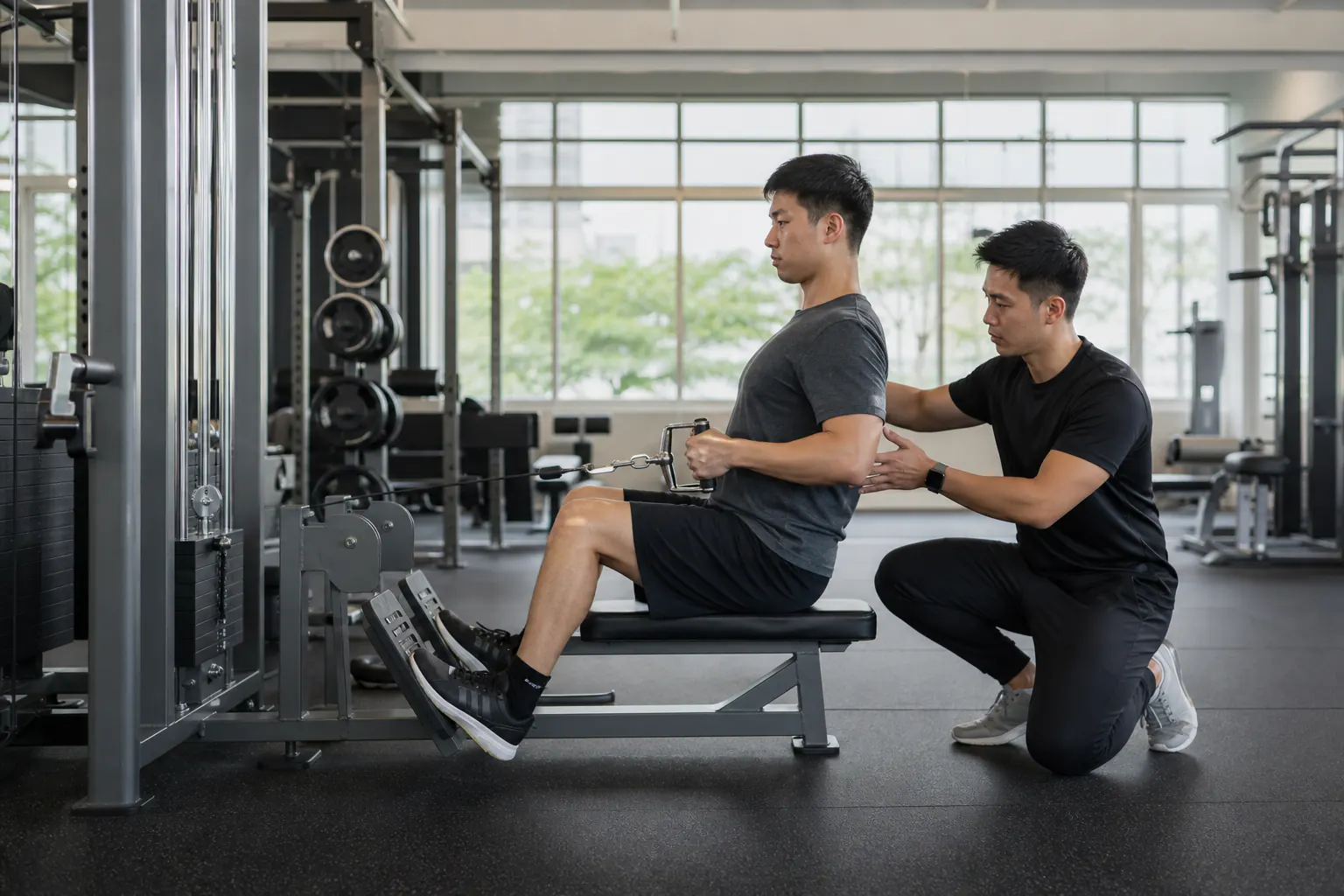
Master the barbell row with this complete form guide. Grip width, body angle, common mistakes, and variations to build a thick, strong back.
The barbell row is the best exercise for building a thick, muscular back. Pull-ups build width. Rows build thickness. If your back lacks depth - if it looks flat from the side - your rowing is either insufficient or your technique needs work.
Most people row too heavy with too little range of motion. Here is how to do it properly.
The Conventional Barbell Row
Setup
- Stand with feet hip-width apart, barbell over your mid-foot
- Hinge at your hips, pushing them back, until your torso is roughly 30-45 degrees above horizontal
- Grip the bar slightly wider than shoulder width, overhand grip
- Soft bend in your knees - not locked, not deeply bent
- Flat back - neutral spine from your head to your tailbone
- Let the bar hang at arm's length below your chest
The Pull
- Pull the bar to your lower chest/upper abdomen - not your belly button, not your neck
- Drive your elbows behind your body, squeezing your shoulder blades together
- Hold the top position for a full second - you should feel a hard contraction in your mid-back
- Lower the bar under control - 2 seconds down
- Full arm extension at the bottom - do not short the range of motion
Common Cues That Work
- "Pull with your elbows, not your hands" - shifts focus from biceps to back
- "Stuff your shoulder blades into your back pockets" - cues retraction
- "Chest proud" - prevents upper back rounding
- "Squeeze an orange between your shoulder blades" - ensures full contraction at the top
Barbell Row Variations
Pendlay Row (Strict Row)
Named after Olympic weightlifting coach Glenn Pendlay. The bar starts and returns to the floor each rep.
Key differences from conventional:
- Torso completely parallel to the floor (more horizontal)
- Bar returns to the floor between reps (dead stop)
- Explosive pull from the floor
- No momentum or body English
This is the strictest form of barbell row. It eliminates momentum and ensures each rep starts from a dead stop. Heavier lifters find this variation challenging on the lower back due to the parallel torso angle.
3-4 sets of 5-6 reps works well. These respond best to moderate-heavy loading with lower reps.
Yates Row (Underhand, More Upright)
Popularised by six-time Mr. Olympia Dorian Yates. Uses an underhand (supinated) grip with a more upright torso.
Key differences:
- Supinated grip (palms facing up)
- Torso at 60-70 degrees from horizontal (more upright)
- Bar pulls to the lower abdomen
- Greater bicep involvement
The underhand grip allows heavier loading and more bicep contribution. Some lifters find this easier on their lower back due to the more upright position.
3-4 sets of 6-8 reps. The more upright position allows slightly higher reps than the Pendlay variation.
Seal Row (Chest-Supported)
Lie face down on an elevated bench with the barbell hanging below. Pull the bar to the bench.
Advantages:
- Zero lower back stress
- Eliminates all momentum
- Pure upper back and lat work
- Great for lifters with lower back issues
Setting this up requires either a dedicated seal row bench (rare in Malaysian gyms) or creativity - stacking two flat benches side by side at equal height, or using a bench on blocks.
3-4 sets of 8-12 reps. The elimination of momentum makes these humbling.
Grip Width and Its Effect
Narrow grip (hands inside shoulder width): Greater range of motion, more lat involvement, higher bicep contribution. Good for building lat thickness.
Standard grip (hands at or slightly outside shoulder width): Balanced recruitment across lats, rhomboids, and mid-traps. The default choice.
Wide grip (hands 1.5x shoulder width): Shorter range of motion, more rear delt and mid-trap emphasis. Less lat contribution. Good for upper back thickness but sacrifices overall range.
For most people, a standard grip provides the best overall back development. Rotate grip widths across training cycles for variety.
How Heavy Should You Row?
The barbell row is one of the most commonly ego-lifted exercises. Here are realistic strength standards for Malaysian male lifters (body weight ratios):
| Level | Row Weight (relative to body weight) |
|---|---|
| Beginner | 0.5x body weight for 8 reps |
| Intermediate | 0.75x body weight for 8 reps |
| Advanced | 1x body weight for 8 reps |
| Strong | 1.25x body weight for 5 reps |
For a 75kg lifter, an intermediate barbell row is roughly 55-60kg for 8 clean reps. Not 80kg swung up with excessive body momentum.
If you need to heave your body upward, swing the bar, and barely get it to your stomach, the weight is too heavy. Drop it by 20% and do the exercise properly.
Programming the Barbell Row
In a Push-Pull-Legs Split
Pull Day:
- Barbell row: 4x6-8 (primary horizontal pull)
- Pull-ups or lat pulldown: 4x8-10 (primary vertical pull)
- Face pulls: 3x15-20 (rear delt/rotator cuff)
- Dumbbell curl: 3x10-12
In an Upper-Lower Split
Upper Day:
- Bench press: 4x5-6
- Barbell row: 4x6-8
- Overhead press: 3x8-10
- Cable row: 3x10-12
- Lateral raises: 3x12-15
In a Full Body Programme
Train the barbell row 2-3 times per week, alternating with other rowing variations:
- Monday: Barbell row 4x6
- Wednesday: Dumbbell row 3x10
- Friday: Pendlay row 3x5
Common Mistakes
Torso rising during the pull. Your torso angle should stay constant throughout the set. If you need to stand more upright to complete the rep, the weight is too heavy.
Short range of motion. If the bar only moves 15cm before you drop it, you are missing 60% of the movement. Full extension at the bottom, full contraction at the top.
Excessive lower back rounding. Some rounding is normal under heavy loads, but if your lower back looks like a fishing rod, reduce the weight and brace your core harder.
Bouncing the bar off your stomach. The bar should touch your body gently at the top - not slam into your ribs. If it bounces, you are using momentum instead of muscle.
Neglecting the eccentric. Dropping the bar after every rep robs you of half the exercise's benefit. Control the lowering phase for 2 seconds minimum.
Using straps too early. Your grip should be strong enough to handle your rowing weight without straps. Use them only when grip genuinely limits your heaviest sets. Train grip strength alongside rowing strength.
Building Your Row: A 12-Week Progression
Assuming you can currently row 50kg for 8 reps:
Weeks 1-4: 50kg, 4x8. Focus on perfect technique. Weeks 5-6: 52.5kg, 4x7-8. Small weight increase. Weeks 7-8: 55kg, 4x6-7. Another small bump. Weeks 9-10: 57.5kg, 4x6. You are getting strong. Week 11: Deload - 45kg, 3x8. Week 12: Test - 60kg for max reps.
Slow, consistent progression. Your back will be visibly thicker after 12 weeks of this approach compared to randomly loading the bar each session.
The barbell row is not flashy. It does not attract attention. But the lifters with the most impressive backs in any gym - here in Malaysia or anywhere else - are the ones who row consistently, with proper form, for years. Be one of them.
Part of our comprehensive guide:
The Complete Guide to Personal Training Methods in Malaysia→Also in this series:
Related Articles
Find a Personal Trainer
Ready to put this into practice? Connect with a certified personal trainer near you, or explore by service and goal.