Step-by-step pull-up progression plan using bands, machines, and negatives. Go from zero pull-ups to your first unassisted rep in 8-12 weeks.
You cannot do a pull-up. That is okay. Most people walking into a gym for the first time cannot. Most people who have been going to the gym for years still cannot, because they never follow a structured plan to get there.
The pull-up is one of the most rewarding exercises to achieve. It requires relative strength (your strength relative to your body weight), upper body pulling power, grip endurance, and core stability. Earning your first pull-up takes deliberate progression over 8-12 weeks.
Here is the exact plan.
Why Pull-Ups Are Hard
A pull-up requires you to move your entire body weight through a vertical pulling motion. For a 75kg person, that means your lats, biceps, and rear delts must collectively produce enough force to lift 75kg from a dead hang to chin-above-bar height.
Compare that to a lat pulldown at 40kg - the most common substitute. You are moving slightly more than half your body weight in a seated, stabilised position. The pull-up demands significantly more.
Factors that make pull-ups harder:
- Higher body weight (every extra kg you carry is extra resistance)
- Low relative upper body strength
- Weak grip
- High body fat percentage (adds weight without adding pulling strength)
- Lack of practice at the specific movement pattern
The good news: all of these are trainable.
Phase 1: Build Foundational Strength (Weeks 1-3)
Before touching the pull-up bar, build the muscles that pull-ups require.
Dead Hangs - 3x max hold
Hang from a pull-up bar with straight arms and a shoulder-width overhand grip. Hold as long as you can. Aim for 20-30 seconds initially, building to 45-60 seconds.
This builds grip strength and conditions your shoulders for the overhead loaded position. If you cannot hang for 20 seconds, grip strength is your first bottleneck.
Lat Pulldown - 4x8-12
Use a wide overhand grip. Pull the bar to your upper chest, squeezing your lats at the bottom. Control the return - do not let the weight slam.
Start at a weight you can handle for 12 clean reps. Add 2.5-5kg when you can complete 4 sets of 12.
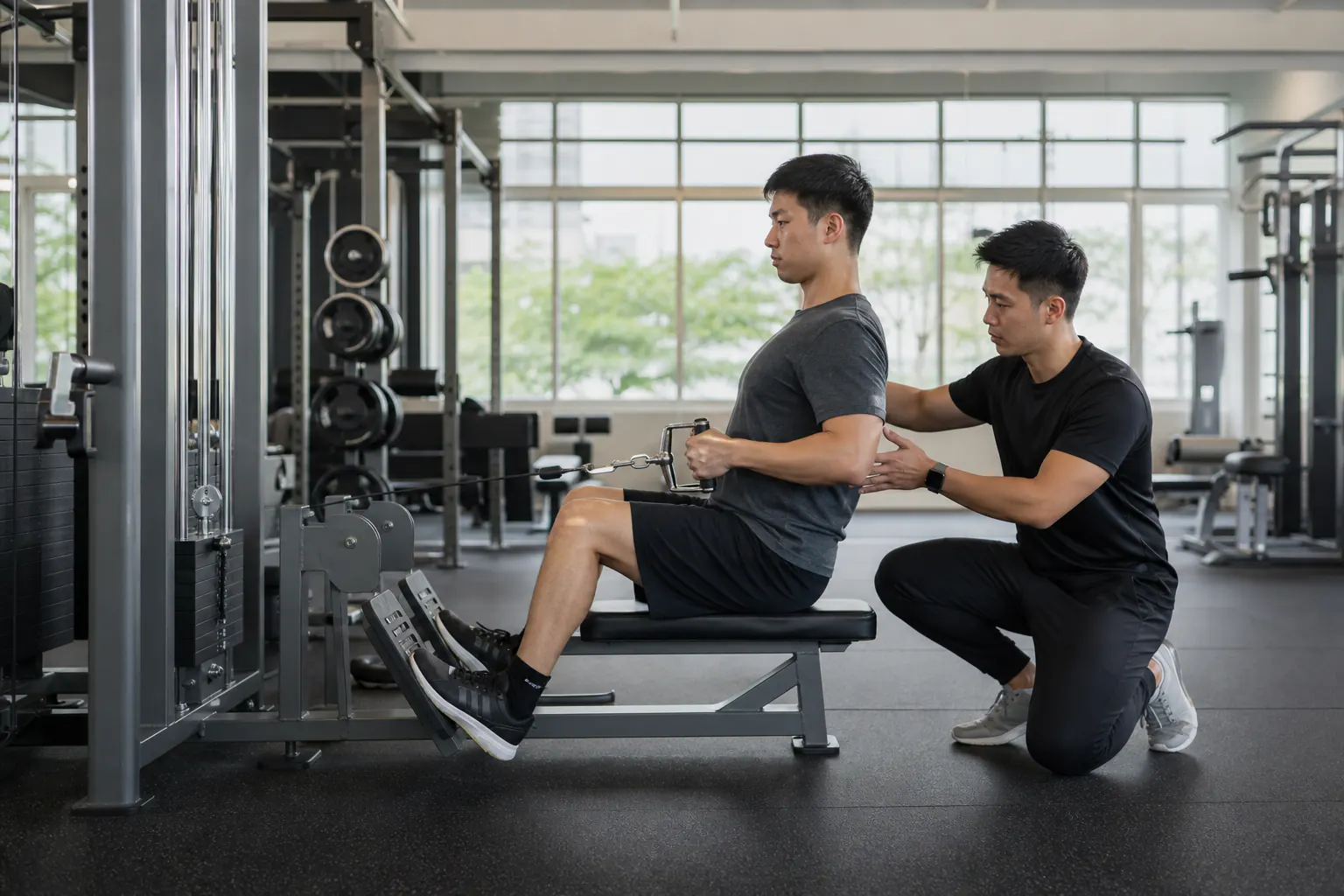
Seated Cable Row - 3x10-12
Builds horizontal pulling strength and mid-back thickness. Use a close-grip handle, pull to your lower chest, squeeze your shoulder blades together.
Dumbbell Bicep Curls - 3x10-12
Your biceps assist during pull-ups. Weak biceps limit your pulling ability. Simple curls with 8-12kg dumbbells build the necessary arm strength.
Scapular Pull-Ups - 3x8-10
Hang from the bar, then pull your shoulder blades down and together without bending your elbows. You will rise a few centimetres. This activates the scapular muscles that initiate the pull-up.
Phase 2: Assisted Pull-Up Variations (Weeks 4-7)
Now you start practicing the actual pull-up pattern with assistance.
Option A: Band-Assisted Pull-Ups
Loop a resistance band over the pull-up bar. Place your knee or foot in the band. The band provides assistance at the bottom (where you are weakest) and less assistance at the top.
Band progression (strongest to lightest):
- Heavy band (green/purple, ~30-50kg assistance) - Week 4-5
- Medium band (red, ~15-25kg assistance) - Week 5-6
- Light band (yellow/orange, ~5-15kg assistance) - Week 6-7
Bands cost RM15-60 each at Decathlon or Shopee. Buy a set of 3 different resistances.
Programming:
- Week 4: Heavy band, 4 sets of 5-6 reps
- Week 5: Medium band, 4 sets of 5-6 reps
- Week 6: Light band, 4 sets of 4-6 reps
- Week 7: Lightest band possible, 4 sets of 3-5 reps
Option B: Machine-Assisted Pull-Ups
Most commercial gyms in Malaysia (Fitness First, Celebrity Fitness, Anytime Fitness) have assisted pull-up machines. You kneel or stand on a platform that counterbalances a portion of your body weight.
Programming:
- Start with 50-60% of your body weight as assistance
- Reduce assistance by 5kg every 1-2 weeks
- 4 sets of 6-8 reps
Option C: Slow Negatives (Eccentric Pull-Ups)
Jump or step up so your chin is above the bar. Then lower yourself as slowly as possible. Aim for 5-8 seconds per negative rep.
Programming:
- 3 sets of 3-5 negative reps, 5-second lowering
- Progress to 8-second lowering as you get stronger
Negatives are particularly effective because your muscles can handle more load during the eccentric (lowering) phase than the concentric (pulling up) phase. You are building pull-up-specific strength at a higher intensity than assisted variations.
Combination Approach (Recommended)
In each session, combine methods:
- Band-assisted pull-ups: 3 sets of 5-6
- Slow negatives: 2 sets of 3-4
- Lat pulldown (heavier than before): 3 sets of 8
This gives you pattern practice, eccentric overload, and volume - all three drivers of pull-up strength.
Phase 3: The First Unassisted Rep (Weeks 8-10)
By week 8, you should be able to do band-assisted pull-ups with the lightest band for 5+ reps and slow negatives lasting 8+ seconds. Your first unassisted pull-up is close.
Testing Your First Rep
After a thorough warm-up (dead hangs, scapular pull-ups, a few band-assisted reps):
- Hang from the bar, full dead hang
- Take a deep breath
- Pull your elbows down toward your hips with maximum effort
- Get your chin over the bar
- Lower with control
If you get it - congratulations. If not, you are within 1-2 weeks. Keep running Phase 2 programming and test again next week.
Tips for Getting That First Rep
- Test when fresh. Do it at the beginning of your workout, not after fatiguing your lats and biceps.
- Use a full dead hang start. Jumping into a partial rep does not count.
- Brace your core. A tight midsection prevents energy leakage through your trunk.
- Pull the bar to you - mentally, think about pulling the bar down rather than pulling yourself up. This cue activates the lats more effectively.
Phase 4: Building Volume (Weeks 10-12+)
One pull-up is an achievement. Now build from 1 to 5, then 5 to 10.
Grease the Groove
Do 1 pull-up every time you walk past a pull-up bar. If your gym has a bar near the entrance, do a single rep on the way in and on the way out. Accumulate 6-10 singles throughout your day (if you have access to a bar at home or office).
This method, popularised by Pavel Tsatsouline, works brilliantly for pull-ups because it practices the movement frequently without accumulating fatigue.
Ladder Sets
Set 1: 1 rep. Rest 30 seconds. Set 2: 2 reps. Rest 45 seconds. Set 3: 3 reps. Rest 60 seconds. Set 4: 2 reps. Rest 45 seconds. Set 5: 1 rep.
Total: 9 reps across 5 sets. As you get stronger, start the ladder higher (2-3-4-3-2 = 14 reps).
Supplemental Band Work
Continue using light bands for higher-rep sets (8-12 reps) to accumulate volume that you cannot yet achieve unassisted.
Common Mistakes
Kipping. Using momentum to get your chin over the bar does not build the strength needed for strict pull-ups. Kipping pull-ups are a different exercise with a different purpose.
Partial reps. If your chin does not clear the bar, the rep does not count. Partial reps build partial strength.
Training pull-ups too infrequently. Once per week is not enough for skill development. Train them 3-4 times per week for fastest progress.
Neglecting body weight. If you are carrying excess body fat, losing 5-10kg will make pull-ups dramatically easier. A 90kg person cutting to 80kg just reduced their pull-up load by 11%.
Skipping progression. Jumping from machine-assisted pull-ups to attempting unassisted reps skips the critical band and negative phases. Follow the progression.
Timeframe Expectations
- Lighter individuals (under 70kg) with some training base: 6-8 weeks
- Average weight (70-85kg) with moderate strength: 8-12 weeks
- Heavier individuals (85kg+) or complete beginners: 12-16 weeks
- Women (generally lower upper body strength relative to body weight): 12-20 weeks
These are honest timelines. Anyone promising pull-ups in 2 weeks is selling something. The pull-up requires genuine strength development, and that takes time. Stay consistent, follow the progression, and your first rep will come. Then the second. Then five. Then ten.
Every strong lifter started at zero. Your first pull-up is waiting.
Part of our comprehensive guide:
The Complete Guide to Personal Training Methods in Malaysia→Also in this series:
Related Articles
Find a Personal Trainer
Ready to put this into practice? Connect with a certified personal trainer near you, or explore by service and goal.