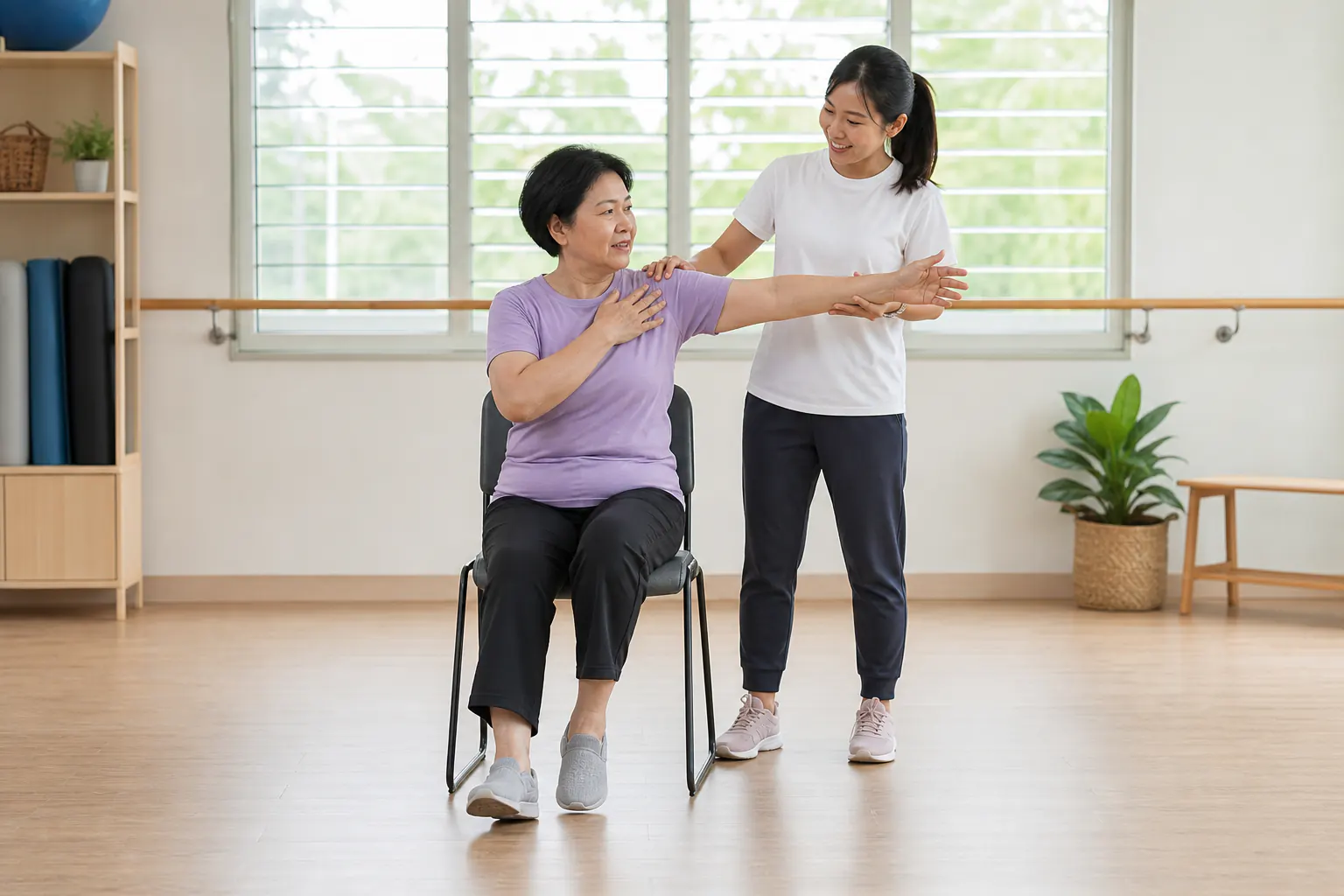
Flat feet affect your squat, running, and overall movement. Learn exercises to strengthen fallen arches and correct movement patterns at the gym.
Flat feet (pes planus) are more common than most people realise. Your foot arch collapses when standing, causing the entire sole to contact the ground. This isn't just a cosmetic issue - flat feet change the mechanics of your entire lower body, from your ankles through your knees, hips, and even your lower back.
Many of my clients in KL don't know they have flat feet until I assess their movement patterns and trace their knee pain, shin splints, or squat difficulties back to their foot mechanics.
The Wet Footprint Test
Want to check if you have flat feet? It takes 30 seconds:
- Wet the bottom of your foot
- Step onto a piece of dark paper or cardboard
- Examine the footprint
Normal arch: You see your heel, the ball of your foot, and a curved connection on the outside edge. The inner arch doesn't touch.
Flat foot: Your entire foot touches - there's little to no visible arch. The footprint looks like a rectangle rather than a footprint.
High arch: Only your heel and ball of foot touch, with a very thin or no connection on the outside.
How Flat Feet Affect Your Training
Squat Mechanics
Flat feet cause the ankle to collapse inward (pronation), which pushes the knee inward (valgus). This compromises squat depth, stability, and power output. If you notice your knees caving during squats, flat feet may be a contributing factor.
Running and Cardio
Excessive pronation during running increases the load on the medial (inner) structures of the knee and shin. This is a primary risk factor for:
- Shin splints (medial tibial stress syndrome)
- Plantar fasciitis
- Achilles tendinopathy
- Runner's knee (patellofemoral pain)
- IT band syndrome
Deadlift Setup
Flat feet reduce the stability of your base during deadlifts. The arch acts like a spring - it stores and returns energy during loaded movements. Without a functional arch, you lose some force transfer from the ground through your legs.
Can You Fix Flat Feet?
Flexible flat feet (most common) - where the arch is present when sitting but collapses when standing - can be significantly improved with strengthening exercises. The muscles and connective tissues that support the arch can be trained to function better.
Rigid flat feet (less common) - where the arch is absent regardless of position, often due to bone structure - cannot be fully corrected with exercise, but symptoms can be managed. Custom orthotics may be necessary.
Most adults with flat feet have the flexible variety, meaning exercise-based correction is possible and worthwhile.
Exercises to Strengthen Flat Feet
1. Short Foot Exercise (Foot Doming)
The single most important exercise for arch development.
- Sit in a chair with your foot flat on the floor
- Without curling your toes, try to shorten your foot by pulling the ball of your foot toward your heel
- You're creating an arch by activating the intrinsic foot muscles
- Your toes should stay flat on the ground - they shouldn't grip or curl
- Hold for 5-10 seconds, relax
- 3 sets of 10 reps per foot, daily
This exercise is subtle and difficult at first. Most people can't do it properly for the first week. That's normal - your brain needs to reconnect with foot muscles it hasn't consciously used.
2. Towel Scrunches
- Place a small towel on a smooth floor
- Sit with your foot on the towel
- Scrunch the towel toward you using only your toes
- Spread the towel back out, repeat
- 3 sets of 10 scrunches per foot
3. Marble Pick-Ups
- Scatter 15-20 marbles (or small objects) on the floor
- Pick them up one at a time with your toes and place them in a cup
- Do all marbles with one foot, then switch
- Builds toe dexterity and intrinsic foot strength
4. Calf Raises (With Arch Focus)
- Stand on one foot on a step, heel hanging off
- Rise up onto your toes, focusing on pushing through the big toe
- At the top, actively engage your arch (short foot position)
- Lower slowly
- 3 sets of 12-15 per foot
5. Tibialis Posterior Strengthening
The tibialis posterior is the primary muscle supporting the arch. When it's weak, the arch collapses.
Resistance band inversion:
- Sit with legs extended
- Loop a resistance band around your forefoot
- Anchor the band to a fixed object on the outer side
- Turn your foot inward against the band resistance
- 3 sets of 15-20 per foot
6. Single-Leg Balance
- Stand on one foot for 30-60 seconds
- Focus on maintaining arch position - don't let your foot collapse inward
- Progression: close your eyes, stand on a pillow or folded towel
- 3 sets per foot, daily
7. Barefoot Walking
Walking barefoot on natural surfaces (grass, sand) activates the intrinsic foot muscles that shoes suppress. In Malaysia, this is easy - walk barefoot in your home (many Malaysians already do), on beach sand, or on grass at a park.
Even 10-15 minutes of barefoot walking daily can strengthen the foot over time.
Footwear Recommendations for Flat-Footed Lifters
For the Gym
Flat, firm-soled shoes are best for lifting: Converse Chuck Taylors, Vans Old Skool, or dedicated lifting shoes (Nike Romaleos, Adidas Adipower). These provide a stable base without excessive cushioning that allows the foot to collapse further.
Avoid: Soft, heavily cushioned running shoes for lifting. The squishy sole makes balance worse and allows more pronation.
For Running
If you run with flat feet, consider:
- Stability or motion control shoes - Brooks Adrenaline, ASICS GT series, New Balance 860. These have medial post technology that resists excessive pronation.
- Custom orthotics - if off-the-shelf shoes don't resolve your pain. Available from podiatrists in Malaysia (RM300-800 for custom-moulded orthotics at private clinics).
For Daily Wear
Avoid completely flat shoes like flip-flops (selipar) for extended walking. They provide zero arch support and can worsen flat foot symptoms. In Malaysia, where flip-flops are cultural footwear, at least limit them to short-distance use.
Modifying Gym Exercises for Flat Feet
Squats
- Use a heel elevation - place small weight plates (2.5kg) under your heels or wear lifting shoes with a raised heel. This reduces the ankle mobility demand and allows you to squat deeper without pronation.
- Focus on "spreading the floor" with your feet - actively push your knees outward over your toes. This externally rotates the hip and creates arch tension.
- Cue: "Tripod foot" - distribute weight evenly across the big toe, little toe, and heel. This naturally creates arch engagement.
Deadlifts
- Wear flat shoes or lift barefoot (if your gym allows - some Malaysian gyms are strict about this)
- Set up with a wider stance if conventional deadlift causes foot collapse
- Sumo deadlift may feel more natural for flat-footed lifters
Running
- Start with shorter distances and progress gradually
- Run on softer surfaces when possible (grass, running tracks) rather than concrete
- Consider alternating between running and lower-impact cardio (cycling, swimming) to reduce repetitive foot stress
Orthotics: When to Consider Them
Consider custom orthotics if:
- You've done foot strengthening exercises consistently for 8-12 weeks without improvement
- You have rigid flat feet (no arch even when not weight-bearing)
- You experience chronic pain in your feet, shins, knees, or hips related to flat feet
- Your flat feet are causing significant gait abnormalities
Orthotics can be obtained in Malaysia from:
- Podiatrists - Pantai Hospital, Sunway Medical, and private podiatry clinics
- Sports medicine clinics - many offer gait analysis and orthotic fitting
- Off-the-shelf insoles - Scholl, Superfeet, or similar brands from pharmacies (RM50-150) can provide moderate support while you work on strengthening
The Long-Term Approach
Flat foot correction is not a quick fix. Expect 3-6 months of consistent daily exercises before seeing meaningful structural improvement. The intrinsic foot muscles are small and slow to develop. But the payoff is worth it: less pain, better movement mechanics, improved gym performance, and reduced injury risk.
Do the short foot exercise daily. Walk barefoot at home. Wear appropriate shoes. And be patient - your feet have been collapsing for years. Rebuilding them takes time.
Part of our comprehensive guide:
Recovery and Injury Prevention: Build Durability Into Your Training→Also in this series:
Related Articles
Find a Personal Trainer
Ready to put this into practice? Connect with a certified personal trainer near you, or explore by service and goal.