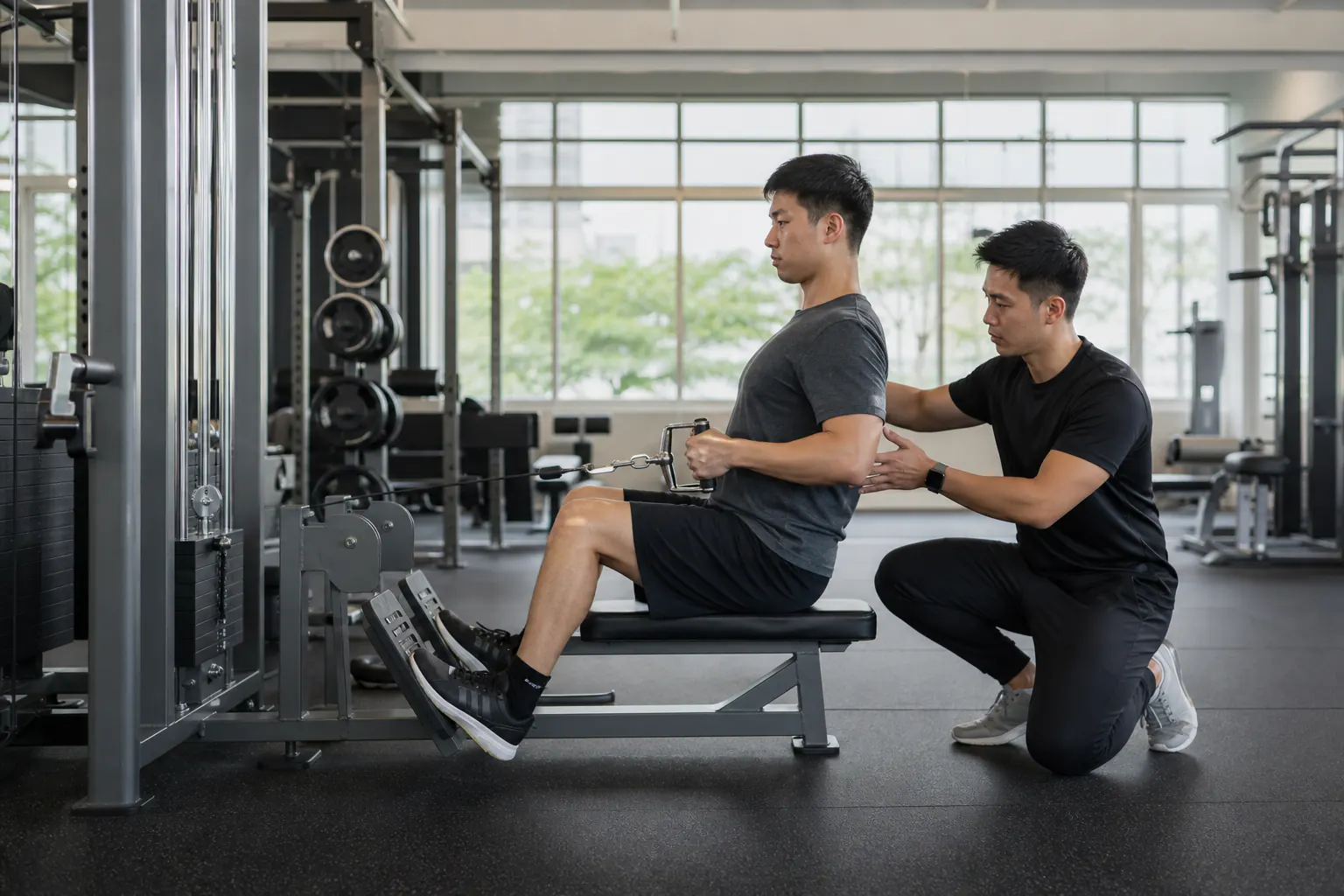
Build bigger calves with the seated calf raise. Targets the soleus muscle that standing raises miss.
The seated calf raise targets the soleus - a thick muscle beneath the gastrocnemius that makes up 60% of your calf mass. Standing calf raises mainly hit the gastrocnemius. For complete calf development, you need both.
Why the Soleus Matters
The soleus is a slow-twitch dominant muscle that responds to high reps and time under tension. It is the muscle that gives calves width when viewed from the front. If your calves look big from the back but flat from the front, your soleus is underdeveloped.
Technique
- Sit in the seated calf raise machine with the pad on your lower thighs
- Place the balls of your feet on the platform - heels hanging off
- Release the safety, lower your heels as far as possible (full stretch)
- Push through the balls of your feet to raise your heels as high as possible
- Squeeze at the top for 2 seconds
- Lower slowly (3 seconds) to full stretch
Programming
- Rep range: 12-20 reps (soleus responds to higher reps)
- Sets: 4-5 sets (calves need volume)
- Tempo: Slow - 3 seconds down, 2 second squeeze, 2 seconds up
- Frequency: 3-4 times per week (calves recover quickly)
If Your Gym Has No Seated Calf Raise Machine
Place a heavy dumbbell on each knee while seated on a bench, feet on a step or plate. Same movement, same benefit. In Malaysian gyms, a 20-25kg dumbbell on each knee works well for most people.
The Calf Training Truth
Calf genetics play a significant role - some people build big calves easily, others struggle despite years of training. But even genetically challenged calves respond to high-frequency, high-volume training. Train them 4 times per week for 3-4 months and honestly assess your progress.
Part of our comprehensive guide:
Muscle Building Fundamentals: A Complete Malaysian Guide→Also in this series:
Related Articles
Find a Personal Trainer
Ready to put this into practice? Connect with a certified personal trainer near you, or explore by service and goal.