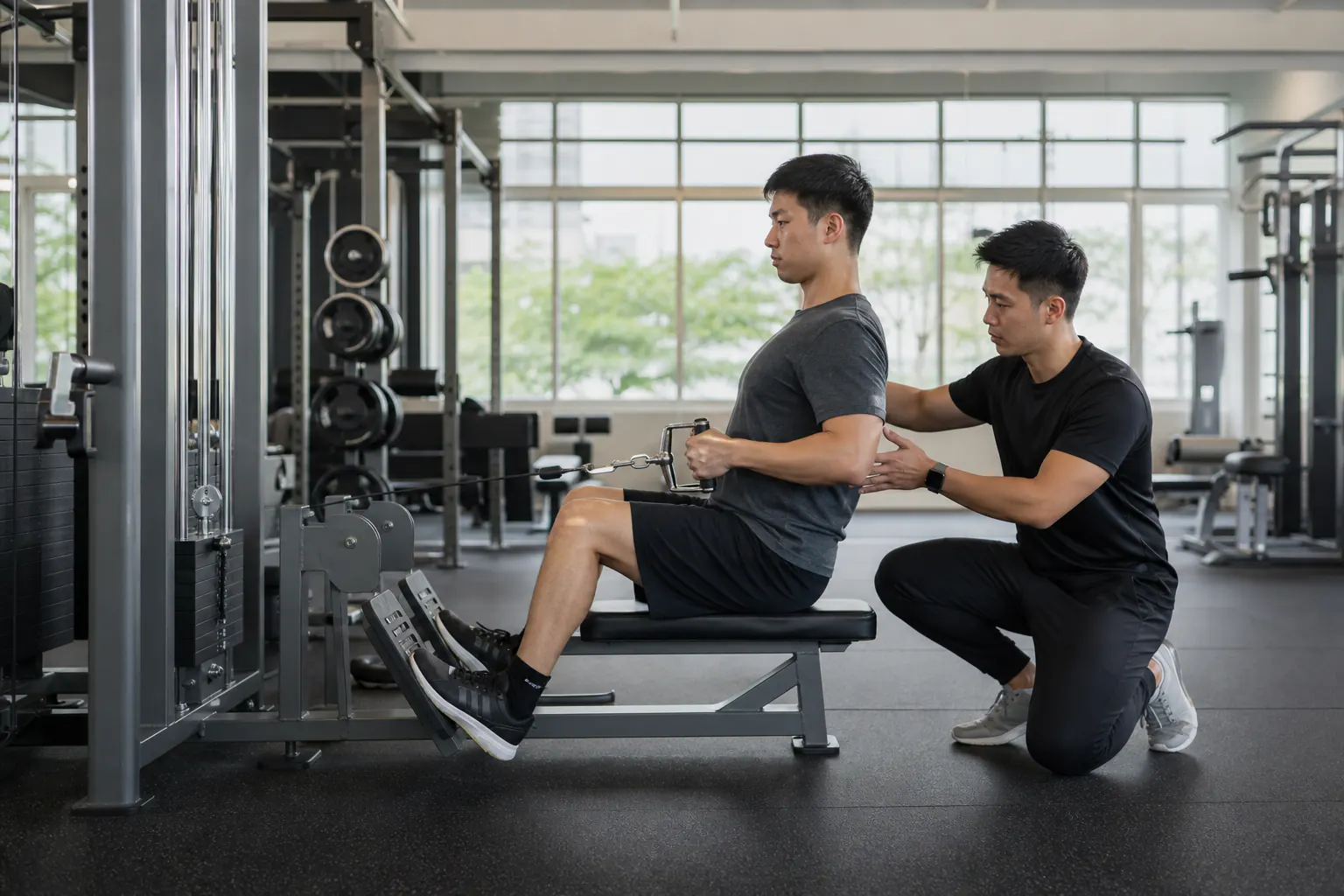
Master the chest supported row for back thickness without lower back strain. Complete technique guide with variations for Malaysian gym-goers.
The chest supported row is one of the most underutilised back exercises in Malaysian gyms, yet it might be the most effective rowing variation for pure muscle building. By supporting your chest on a bench, you remove the lower back from the equation entirely, allowing you to focus every ounce of effort on your back muscles without worrying about spinal fatigue or form breakdown.
If you have been relying solely on bent-over rows and cable rows, adding chest supported rows to your arsenal can transform your back development.
Why Chest Supported Rows Excel
Zero Lower Back Stress
In a bent-over row, your spinal erectors work hard to maintain your hip hinge position. This limits how heavy you can go and how many sets you can perform before your lower back fatigues. After heavy deadlifts or squats, your lower back may be too tired for effective bent-over rowing.
The chest supported position eliminates this entirely. Your lower back gets a complete rest while your upper back, lats, and rear delts receive maximum stimulation. This makes it an ideal exercise to pair with deadlift-heavy training programs.
Reduced Cheating
Without the ability to use momentum from hip extension, every rep must come from pure back muscle contraction. This enforced strictness leads to better muscle activation and more productive sets. You will use less weight than a bent-over row, but the muscles that matter - your back muscles - will work harder.
Better Mind-Muscle Connection
With your chest stabilised and cheating eliminated, it becomes much easier to feel your back muscles working. Many Malaysian gym-goers struggle with mind-muscle connection in their back training, and the chest supported row is one of the best exercises for developing this crucial skill.
Setting Up the Exercise
Using an Incline Bench
Set an adjustable bench to a 30 to 45-degree incline. Lie face down with your chest on the pad and your feet on the floor for stability. Your chin should be just above the top of the bench. Reach down and grab a dumbbell in each hand with arms hanging straight down.
A 30-degree angle emphasises the mid-back and rhomboids, while a 45-degree angle shifts emphasis slightly toward the upper traps and rear delts. Experiment with both.
Using a Dedicated Machine
Some gyms in Malaysia, particularly the larger chains, have dedicated chest supported row machines or T-bar row setups with a chest pad. These are excellent options that provide a fixed movement path and make loading simple.
Using a Flat Bench
Lie face down on a flat bench elevated on blocks or stacked plates, with your arms hanging over the sides. This creates a completely horizontal rowing angle that emphasises the mid-back. You may need to experiment with bench height to find a comfortable position.
Proper Rowing Technique
With the setup complete and dumbbells in hand, initiate the row by retracting your shoulder blades - pulling them together toward your spine. This scapular retraction should begin the movement before your arms bend.
Pull the dumbbells up and slightly back, driving your elbows toward your hips. Squeeze your shoulder blades together hard at the top of the movement and hold for one to two seconds. Lower the weights under control over two to three seconds, allowing your shoulder blades to spread apart at the bottom for a full stretch.
Key cues include leading with your elbows rather than your hands, thinking about pulling your elbows into your back pockets, keeping your chest pressed firmly against the bench throughout, and avoiding shrugging your shoulders toward your ears.
Grip Variations and Their Effects
Pronated Grip (Overhand)
Palms facing behind you. This variation emphasises the rear deltoids, middle trapezius, and rhomboids. It is excellent for posture improvement and upper back thickness.
Neutral Grip (Palms Facing Each Other)
This is the most comfortable grip for most people and allows the longest range of motion. It provides balanced stimulation of the lats and mid-back muscles.
Supinated Grip (Underhand)
Palms facing forward. This grip shifts emphasis toward the lower lats and involves the biceps more heavily. It is similar to how a chin-up targets the back and is excellent for developing lat width.
Variations
Barbell Chest Supported Row
Instead of dumbbells, use a barbell. Set up on the incline bench as usual, but reach down and grip a barbell on the floor below you. This allows slightly heavier loading but reduces the range of motion compared to dumbbells.
Single-Arm Chest Supported Row
Perform the movement one arm at a time. This allows greater range of motion, as you can rotate slightly at the top, and helps identify imbalances between sides. Three sets of 10 to 12 reps per arm.
Chest Supported Row with Rotation
At the top of the single-arm row, rotate your hand from pronated to supinated. This adds a rotational component that increases rear deltoid and bicep involvement.
Seal Row
Lie flat on a bench elevated on blocks. Row a barbell from a dead stop position on the floor. This variation eliminates all momentum and stretch reflex, making each rep harder but more effective. It is called a seal row because the position resembles a seal.
Programming Chest Supported Rows
For Hypertrophy
Three to four sets of 10 to 12 repetitions with a controlled tempo. Use a weight that leaves two reps in reserve. The slow eccentric and paused contraction are more important than the load.
For Strength Support
Four sets of six to eight repetitions with heavier dumbbells. While chest supported rows are primarily a hypertrophy exercise, they can also build meaningful back strength when loaded appropriately.
For Endurance and Pump
Two to three sets of 15 to 20 repetitions with lighter weight and minimal rest between sets. Finish your back workout with these high-rep sets for a massive back pump.
Weekly Placement
Chest supported rows work best as a secondary back exercise after your primary heavy row or pull-up variation. A typical back training day might begin with barbell bent-over rows or weighted pull-ups as the primary strength movement, followed by chest supported rows as the secondary hypertrophy movement, and finishing with cable or machine work for isolation.
Common Mistakes
Lifting Too Heavy
Because cheating is difficult, many people are humbled by how much less they can row compared to unsupported variations. Check your ego and use appropriate weights. A 15-kilogram dumbbell with perfect form will build more back muscle than a 25-kilogram dumbbell yanked with poor technique.
Insufficient Retraction
If you simply bend your arms without pulling your shoulder blades together, you turn a back exercise into an arm exercise. Initiate every rep with scapular retraction.
Bench Too Steep
An angle above 45 degrees starts to resemble an upright row more than a horizontal row, shifting emphasis away from the back and toward the traps and shoulders. Keep the bench at 45 degrees or below.
Rushing Reps
Chest supported rows reward slow, controlled tempo. A two-second concentric, one-second pause, and three-second eccentric per rep ensures maximum time under tension and muscle fibre recruitment.
The Back-Building Staple You Need
If you are a Malaysian gym-goer who has been struggling to feel your back working during rows, or if lower back fatigue is limiting your back training volume, the chest supported row is your solution. It isolates the back muscles you want to grow, protects the lower back you need to preserve, and builds the mind-muscle connection that makes every other back exercise more effective.
Add it to your next back session and feel the difference that true back isolation makes.
Part of our comprehensive guide:
Muscle Building Fundamentals: A Complete Malaysian Guide→Also in this series:
Related Articles
Find a Personal Trainer
Ready to put this into practice? Connect with a certified personal trainer near you, or explore by service and goal.