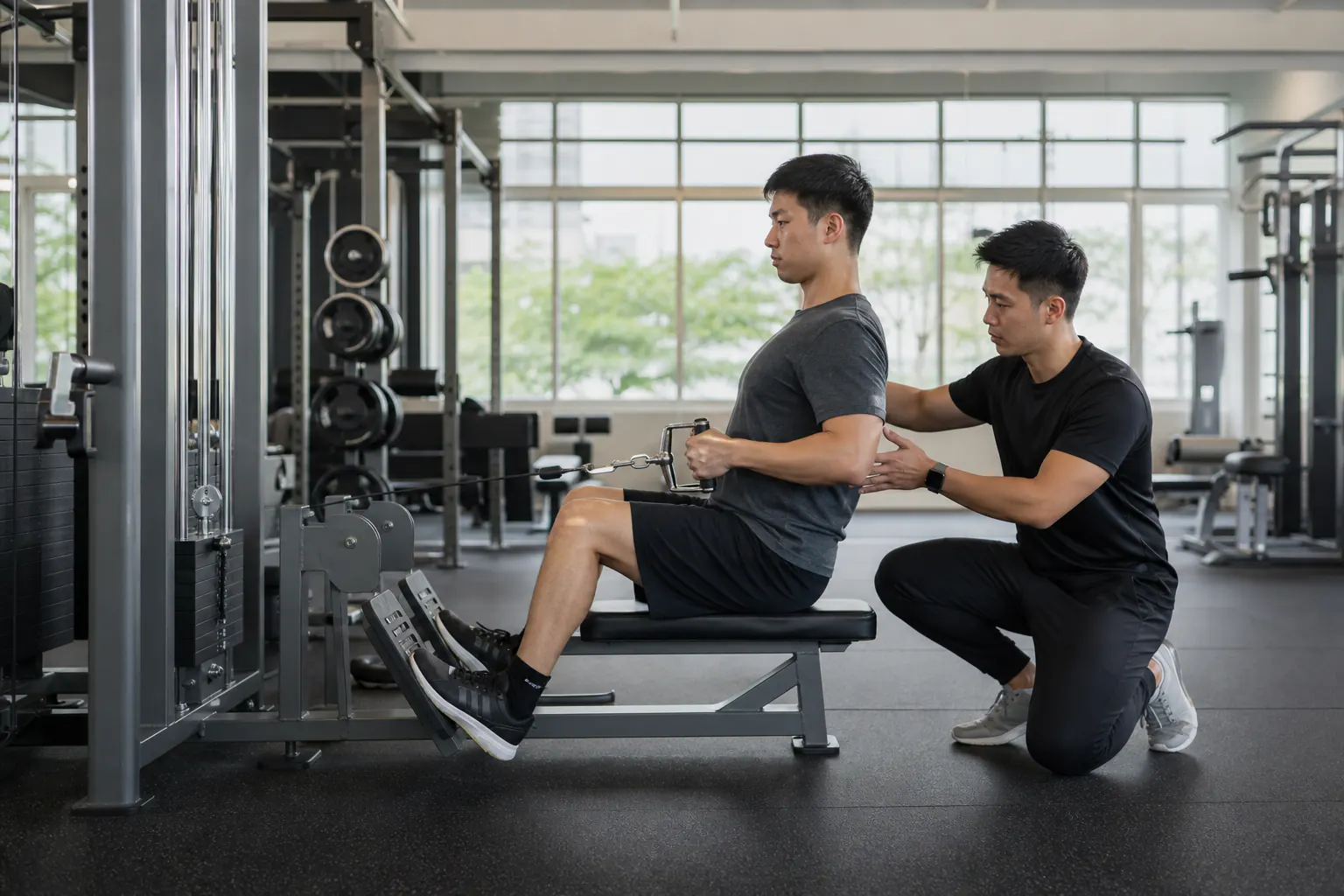
Improve your squat depth and reduce injury risk with these ankle mobility drills. Perfect for Malaysian gym-goers struggling with tight ankles.
If you have ever struggled to hit depth in your squats, felt your heels lifting off the floor, or noticed your knees caving inward during leg exercises, limited ankle mobility might be the hidden culprit. It is one of the most overlooked factors in lower body training, yet it affects everything from your squat mechanics to your running gait.
For many Malaysians who spend long hours seated at office desks or driving through KL traffic, ankle stiffness is incredibly common. Let us fix that.
Why Ankle Mobility Matters
Your ankle joint needs adequate dorsiflexion - the ability to bring your toes toward your shin - for nearly every lower body movement. During a squat, your knees must travel forward over your toes, which requires roughly 35 to 45 degrees of ankle dorsiflexion. Most people with desk-bound lifestyles have significantly less than this.
Poor ankle mobility creates a chain reaction. When your ankles cannot bend sufficiently, your body compensates by rounding your lower back, shifting weight to your toes, lifting your heels, or collapsing your knees inward. These compensations increase injury risk and limit how much weight you can safely handle.
Testing Your Ankle Mobility
Before diving into drills, assess where you stand with a simple wall test. Face a wall and place one foot about 10 centimetres away. Try to touch your knee to the wall without lifting your heel. If you can do it, move your foot back another centimetre and repeat.
A good benchmark is being able to touch the wall with your foot roughly 12 to 15 centimetres away. If you struggle to reach the wall at all, ankle mobility work should become a priority in your training.
Daily Mobility Drills
Wall Ankle Stretch
This is your bread and butter. Stand facing a wall in a split stance with one foot forward. Drive your front knee toward the wall, keeping your heel flat on the ground. Push until you feel a strong stretch in the front of your ankle and the back of your lower calf. Hold for five seconds, release, and repeat for 10 to 15 repetitions per side.
To target different angles, perform the same drill with your knee driving slightly over your little toe, then over your big toe. This addresses the full range of ankle motion.
Banded Ankle Mobilisation
Loop a resistance band around a sturdy post at floor level and place your foot inside the band so it sits across the front of your ankle joint. Step forward to create tension in the band. Now perform the same knee-over-toe movement. The band pulls the talus bone backward, creating space in the joint for better dorsiflexion.
Perform two sets of 15 repetitions per side. You can find suitable resistance bands at any Decathlon store in Malaysia or order them online for under RM30.
Elevated Ankle Stretch
Place the ball of your foot on a raised surface - a weight plate, a thick book, or a door step works perfectly. Let your heel drop toward the ground and gently lean forward. Hold for 20 to 30 seconds. This provides a deeper calf stretch that targets the soleus muscle, which often restricts ankle mobility.
Strengthening Through Range
Mobility without strength is just flexibility. You need to own the range of motion you develop.
Ankle CARs (Controlled Articular Rotations)
Sit on a chair and lift one foot off the ground. Slowly draw the biggest circle possible with your foot by moving only at the ankle. Go clockwise for five rotations, then counterclockwise for five. Focus on making each circle as smooth and large as possible. This drill improves joint health and neurological control.
Tibialis Anterior Raise
Stand with your back against a wall and your feet about 30 centimetres in front of you. Lift your toes off the ground as high as possible, keeping your heels planted. Lower slowly and repeat for three sets of 20 repetitions. The tibialis anterior is the muscle on the front of your shin, and strengthening it directly improves dorsiflexion strength.
You can progress this by performing it one leg at a time or by adding a light resistance band over your toes.
Deep Squat Hold
The simplest way to improve ankle mobility for squatting is to spend time in a deep squat. Aim for a cumulative five minutes per day in the bottom of a squat position. You can break this into 30-second holds throughout the day.
In many traditional Malaysian and Asian cultures, spending time in a deep squat was a normal daily activity. Modern lifestyles with chairs and sofas have robbed us of this natural position. Reclaim it.
Integrating Mobility Into Your Warm-Up
Do not spend 20 minutes on mobility before every workout. Instead, pick two or three drills and perform them as part of a focused five-minute warm-up. A sample routine might include one minute of ankle CARs per side, one minute of wall ankle stretches per side, and one minute of banded mobilisations per side.
Save the longer holds and more extensive work for dedicated mobility sessions at home - perhaps while watching television in the evening.
Temporary Solutions While Building Mobility
Heel Elevation
Placing small weight plates or a wedge under your heels during squats is a legitimate strategy while you work on mobility. Many Olympic weightlifters use raised-heel shoes permanently. You can buy weightlifting shoes in Malaysia from brands like Nike, Adidas, or more affordable options from Decathlon.
Squat Stance Adjustment
A wider stance with toes pointed out slightly reduces the ankle dorsiflexion demand. Experiment with your stance to find a position that allows you to squat deeper while you develop mobility.
The Malaysian Lifestyle Factor
Our warm climate is actually an advantage for mobility work. Warm muscles and connective tissues are more pliable, so your mobility sessions will be more productive than they would be in cold climates. Take advantage of this by doing your drills after a warm shower or later in the day when your body temperature is naturally higher.
However, the prevalence of flip-flops and flat sandals in Malaysian daily life can contribute to ankle stiffness over time. If you wear flat footwear most of the day, make ankle mobility work a non-negotiable part of your routine.
Consistency Is Everything
Ankle mobility improves slowly. Expect to see meaningful changes after four to six weeks of consistent daily work. The ankle joint is surrounded by dense connective tissue and multiple bones, so it responds more slowly than, say, hip mobility work.
Track your progress with the wall test every two weeks. Even a one-centimetre improvement represents a significant change in joint range that will translate directly to better squats, lunges, and overall movement quality.
Your ankles are the foundation of your lower body. Give them the attention they deserve, and every exercise from the ground up will improve.
Part of our comprehensive guide:
The Complete Guide to Personal Training Methods in Malaysia→Also in this series:
Related Articles
Find a Personal Trainer
Ready to put this into practice? Connect with a certified personal trainer near you, or explore by service and goal.