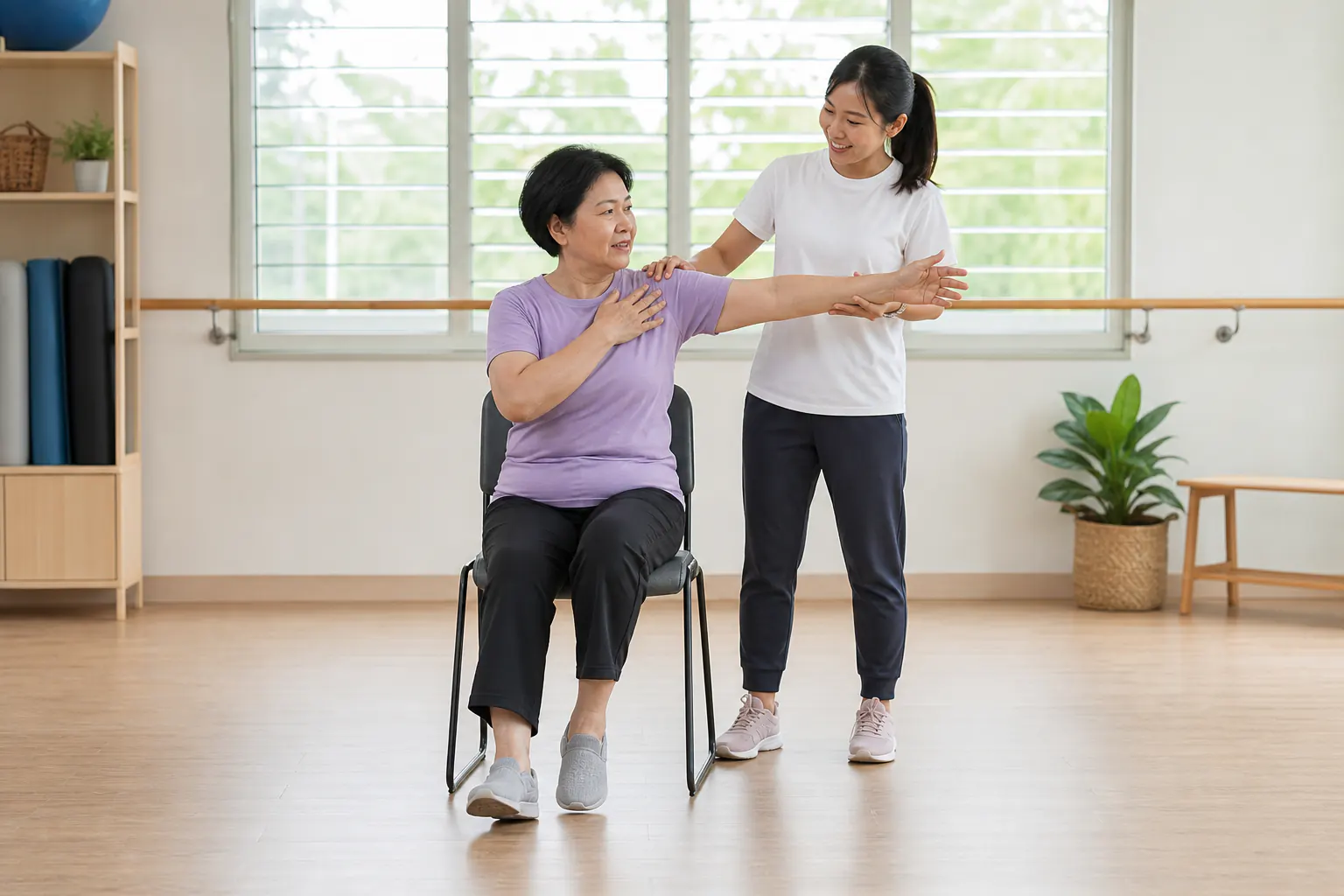
Diastasis recti exercise guide for postpartum recovery. Learn which exercises help close the gap and which ones make it worse.
Diastasis recti is the separation of the rectus abdominis muscles (your "six-pack" muscles) along the midline of your abdomen. It's extremely common during and after pregnancy - studies show it affects 60-100% of pregnant women to some degree by the third trimester, and about 30-40% still have a significant separation at 12 months postpartum.
Despite how common it is, many Malaysian women don't know they have it, don't know what to do about it, and get conflicting advice from doctors, trainers, and the internet. Some are told to just do planks. Others are told never to do any ab exercise ever again. Neither extreme is correct.
What Is Diastasis Recti?
During pregnancy, the growing uterus pushes against the abdominal wall. The connective tissue (linea alba) running vertically down the centre of your abdomen stretches and thins to accommodate. The two halves of the rectus abdominis separate, creating a gap.
A separation of more than 2 finger-widths (roughly 2cm) is considered clinically significant diastasis recti. But the width of the gap isn't the only concern - the depth (how far your fingers sink in when you press) and the tension of the tissue (can the linea alba generate tension when you engage your core?) also matter.
How to Check for Diastasis Recti
- Lie on your back with knees bent
- Place your fingers horizontally across your belly button
- Lift your head and shoulders slightly off the floor (like a small crunch)
- Feel for a gap between the two muscle bellies
- Check above the belly button, at the belly button, and below
- Note both the width (finger-widths) and the depth (how deep your fingers sink)
If you feel a gap wider than 2 fingers or your fingers sink deeply with no resistance, you likely have diastasis recti. See a physiotherapist who specialises in women's health for a proper assessment.
Exercises That HELP Diastasis Recti
The goal is to restore tension to the linea alba and retrain the deep core muscles (transverse abdominis, pelvic floor, diaphragm) to work together.
1. Diaphragmatic Breathing
Before any exercise, learn to breathe properly. This is the foundation of diastasis recti recovery.
- Lie on your back, knees bent
- Place one hand on your chest, one on your belly
- Inhale through your nose - your belly and sides should expand (not your chest)
- Exhale slowly through your mouth - feel your core gently engage inward
- Your pelvic floor should naturally lift on the exhale
- Practice 5 minutes daily
2. Dead Bug (Modified)
- Lie on your back, arms extended to ceiling, knees bent at 90 degrees
- Exhale and slowly extend one leg toward the floor while lowering the opposite arm overhead
- Keep your lower back pressed into the floor - if it arches, you've gone too far
- Inhale and return to start
- 3 sets of 6-8 per side
- Progress by extending the leg further toward the floor as control improves
3. Bird Dog
- On all fours (hands under shoulders, knees under hips)
- Exhale and extend one arm forward and the opposite leg backward
- Keep your hips level - don't rotate
- Hold 3-5 seconds, return, switch sides
- 3 sets of 8 per side
4. Pelvic Floor Engagement (Kegels Plus)
- Sit, stand, or lie down
- On your exhale, gently contract your pelvic floor (imagine stopping the flow of urine)
- Hold for 5-10 seconds while breathing normally
- Release fully
- 3 sets of 10
- Progress by holding longer and engaging during functional movements
5. Heel Slides
- Lie on your back, knees bent
- Exhale and slowly slide one heel along the floor to extend the leg
- Keep your pelvis stable - no rocking or arching
- Inhale and return
- 3 sets of 10 per side
6. Side-Lying Clam
- Lie on your side, knees bent at 45 degrees
- Keep your feet together
- Exhale and lift your top knee, keeping feet touching
- 3 sets of 15 per side
- This strengthens the hip stabilisers, which support pelvic alignment
7. Wall Press
- Stand facing a wall, hands at shoulder height
- Press into the wall while exhaling and engaging your core
- Hold 5-10 seconds
- This is a modified plank that's safe for early diastasis recti recovery
- 3 sets of 10
Exercises to AVOID (Initially)
These exercises can worsen diastasis recti by increasing intra-abdominal pressure that pushes the muscles apart:
Crunches and Sit-Ups
The most common ab exercise is the worst for diastasis recti. The forward flexion motion pushes your abdominal organs against the weakened linea alba, creating a visible "doming" or "coning" of the belly. If you see this doming during any exercise, stop that exercise.
Full Planks (Initially)
Standard planks can create too much intra-abdominal pressure for early-stage diastasis recovery. Start with the wall press or inclined plank (hands on a bench) and progress gradually.
Double Leg Raises
Lifting both legs while lying on your back creates enormous intra-abdominal pressure that most postpartum women can't control.
Russian Twists
Rotational exercises with poor core control can worsen the separation.
Heavy Lifting Without Core Engagement
Lifting heavy weights while holding your breath (Valsalva manoeuvre) dramatically increases intra-abdominal pressure. If you return to lifting, learn to exhale on the effort phase and maintain gentle core engagement throughout.
Progressive Return to Exercise
Phase 1: Foundation (Weeks 1-6 Postpartum)
- Diaphragmatic breathing
- Gentle pelvic floor exercises
- Short walks (10-15 minutes)
- Heel slides and pelvic tilts
- Get clearance from your doctor before starting even gentle exercise
Phase 2: Reconnection (Weeks 6-12)
- Dead bugs and bird dogs
- Side-lying exercises
- Wall presses
- Longer walks (20-30 minutes)
- Begin gentle resistance band exercises for upper and lower body
- Monitor for doming/coning during all exercises
Phase 3: Rebuilding (Months 3-6)
- Progress to incline planks, then full planks (if no doming)
- Goblet squats with light weight
- Resistance training with proper breathing and core engagement
- Gradually increase intensity and load
Phase 4: Full Return (Month 6+)
- Return to normal training with awareness of core engagement
- Heavy compound lifts can resume if the separation has sufficiently closed and core control is good
- Some women may need continued modifications - this is normal and not a failure
The Confinement Period Factor
In Malaysian culture, the confinement period (pantang) typically lasts 30-44 days after delivery. During this time, many women are encouraged to rest completely, eat specific foods, and avoid physical activity.
While rest is important for initial recovery, gentle breathing exercises and very light movement (like short walks within the house) are actually beneficial during confinement and won't interfere with recovery. The deep breathing exercises described above can be started within days of delivery (with doctor approval) and actually accelerate healing.
After confinement, many women want to "bounce back" quickly and jump into intense exercise. This is where injuries and worsening diastasis happen. Follow the progressive phases above and resist the urge to rush.
When to See a Specialist
See a women's health physiotherapist if:
- Your separation is wider than 3 finger-widths at 12 weeks postpartum
- You experience pelvic pain during exercise
- You have urinary incontinence (leaking during exercise, laughing, or sneezing)
- You feel heaviness or bulging in your pelvic floor
- Your diastasis isn't improving after 3 months of consistent exercise
- You see visible doming/coning during daily activities (not just exercise)
In Malaysia, women's health physiotherapists can be found at:
- Private hospitals (Pantai, Gleneagles, Sunway Medical)
- Specialised physio clinics in KL and major cities
- Some offer telehealth consultations if you're not in a major city
Sessions typically cost RM100-200 per visit, and many women see significant improvement within 6-8 sessions when combined with a home exercise programme.
Surgery: A Last Resort
Abdominoplasty (tummy tuck) with diastasis repair is an option for severe cases that don't respond to exercise. However, this should be considered only after:
- At least 6-12 months of consistent exercise-based rehabilitation
- You're done having children (pregnancy will reopen the separation)
- Conservative treatment has failed despite proper adherence
Surgery is common in Malaysia and costs RM15,000-35,000 at private hospitals.
The Truth About "Closing the Gap"
Complete closure of diastasis recti isn't always possible, and that's okay. The real goal is restoring functional core stability - the ability to generate tension across the linea alba and support your spine during daily activities and exercise. Many women with a residual 1-2 finger-width separation function perfectly well and can return to full exercise including heavy lifting.
Focus on function, not just the gap measurement. A 2-finger gap with good tension is better than a 1-finger gap with no ability to generate tension.
Your body grew a human. Give it the time and the right exercises to recover properly. Rush the process and you'll set yourself back. Be patient, be consistent, and work with professionals who understand postnatal recovery.
Related Articles
Find a Personal Trainer
Ready to put this into practice? Connect with a certified personal trainer near you, or explore by service and goal.