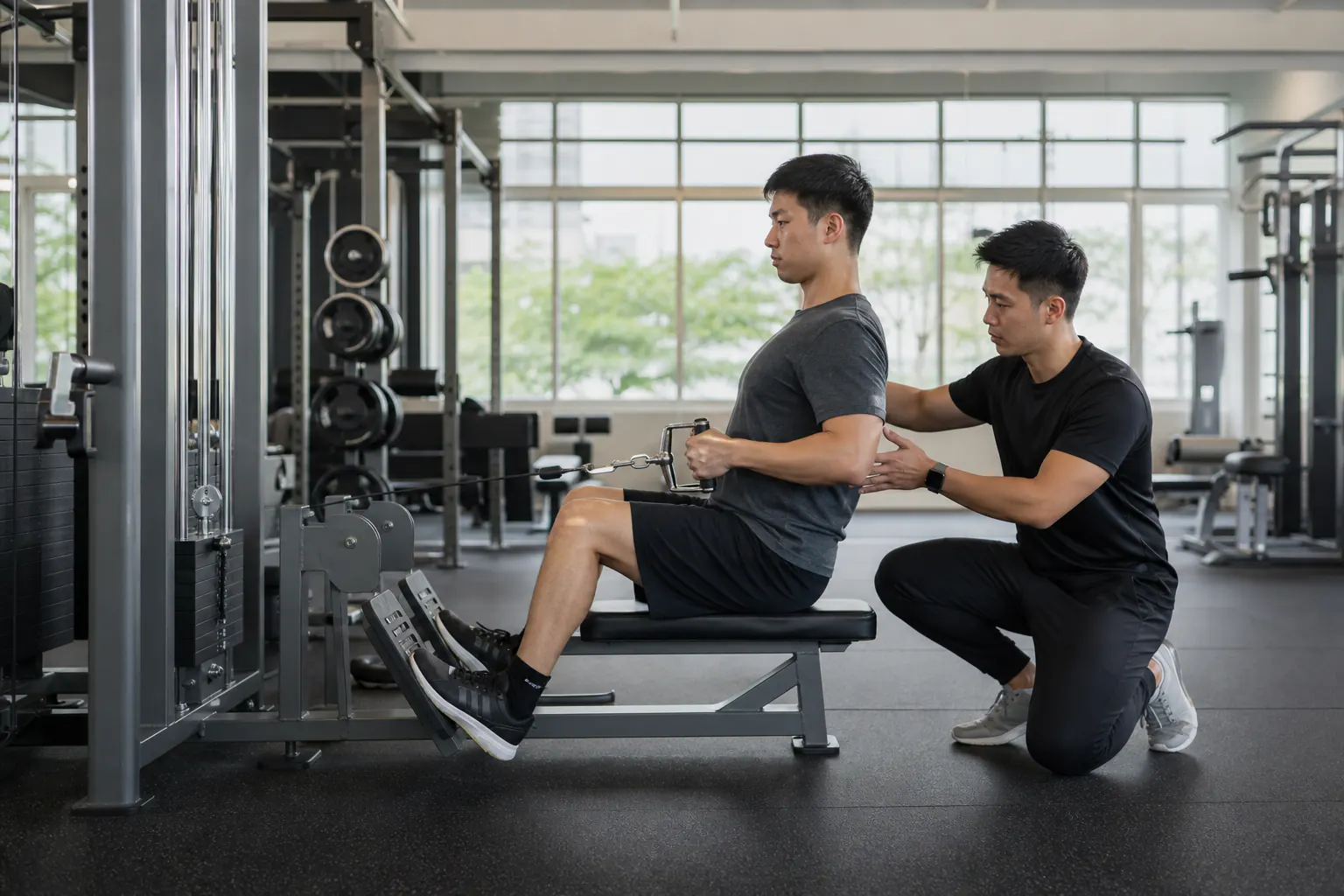
Master the bird dog exercise for bulletproof core stability. Step-by-step technique, progressions, and why this simple movement prevents back pain.
The bird dog looks too easy to be effective. You are on all fours, extending one arm and the opposite leg. No dramatic movement, no heavy load, no sweat-drenched exhaustion. Yet Dr. Stuart McGill - the world's foremost spine biomechanics researcher - considers the bird dog one of the three essential core exercises for spinal health, alongside the curl-up and side plank.
If the leading expert on back pain prevention uses this exercise with professional athletes and post-surgical patients alike, it deserves your attention.
What the Bird Dog Trains
The bird dog is an anti-extension, anti-rotation core exercise. While extending your arm and leg, your core must:
- Resist lumbar extension. Your lower back wants to arch when your leg extends behind you. Your deep core muscles (multifidus, transverse abdominis) fight this.
- Resist rotation. Lifting one arm and the opposite leg creates a rotational force. Your obliques and deep stabilisers resist this rotation to keep your hips and shoulders square.
- Coordinate contralateral movement. The opposite arm-leg pattern (right arm, left leg) trains cross-body coordination that mirrors walking, running, and most athletic movements.
- Activate the glutes. The extending leg requires glute contraction. Many people with lower back pain have "gluteal amnesia" - their glutes do not fire properly. The bird dog retrains this connection.
How to Perform the Perfect Bird Dog
Starting Position
- Hands directly under your shoulders, knees directly under your hips - a true all-fours position
- Spine in neutral - maintain the natural curves of your lower and upper back
- Head in line with your spine - look at the floor about 30cm ahead of your hands
- Brace your core at about 20-30% of maximum effort - not a full bear-down, just enough to stabilise
The Movement
- Simultaneously extend your right arm forward and your left leg backward
- Reach your arm until it is in line with your torso - parallel to the floor
- Extend your leg until it is in line with your torso - parallel to the floor, not higher
- Your thumb should point toward the ceiling and your foot should be dorsiflexed (toes pointing down)
- Hold the extended position for 5-10 seconds
- Return to the starting position with control
- Repeat on the opposite side (left arm, right leg)
The Non-Negotiable Rules
Your hips must stay level. Place a water bottle on your lower back. If it falls off, your hips are rotating. Reduce your range of motion until you can keep the bottle balanced.
Your lower back must not arch. The moment your belly drops toward the floor, you have lost core engagement. Reduce the extension range or hold for a shorter time.
Slow and controlled. Each rep should take 4-6 seconds per side (not counting the hold). This is not a speed exercise. Rushing defeats the purpose entirely.
Breathe. Do not hold your breath. Maintain steady breathing throughout. Exhale gently during the extension, inhale during the return.
Why the Bird Dog Is Effective
It Trains the Core How It Actually Functions
Your core's primary job is not to flex your spine (crunches) or resist external forces in one direction (front planks). In real life, your core stabilises against multiple forces simultaneously - extension, rotation, and lateral flexion - while your limbs move independently.
The bird dog trains exactly this pattern. Your core holds a stable trunk while your arms and legs move freely around it. This is how your core works during squats, deadlifts, running, and every daily activity.
It Is Safe for Almost Everyone
Because there is no spinal loading and the movement is self-limiting (you can only extend as far as your control allows), the bird dog is safe for:
- Complete beginners
- People recovering from lower back injuries
- Post-surgical patients (with medical clearance)
- Pregnant women
- Elderly individuals
- Athletes in any sport
The exercise is so safe that physiotherapists in Malaysia routinely prescribe it within weeks of disc surgery. I have used it with clients ranging from 18-year-old university students to 70-year-old retirees.
It Exposes Weaknesses
The bird dog is remarkably good at revealing core stability deficits that other exercises mask. People who can plank for 2 minutes often cannot hold a proper bird dog for 10 seconds per side without their hips rotating.
If you cannot perform a slow, controlled bird dog with perfect form, your core stability has significant room for improvement - regardless of how strong your lifts are.
Progressions
Level 1: Arm Only or Leg Only
If the full bird dog is too challenging, start with single-limb movements:
Arm only: From all fours, extend one arm forward while keeping both knees on the ground. Hold 5 seconds per side. 3 sets of 8 per side.
Leg only: From all fours, extend one leg backward while keeping both hands on the ground. Hold 5 seconds per side. 3 sets of 8 per side.
Level 2: Standard Bird Dog
The full opposite arm and leg extension described above.
- 3 sets of 8-10 per side
- 5-10 second holds
- Water bottle balance test
Level 3: Bird Dog with Elbow-to-Knee Touch
After extending, bring your elbow and knee together underneath your body (they should touch or nearly touch), then re-extend. This adds a dynamic element while maintaining the anti-rotation demand.
- 3 sets of 8 per side
- Controlled tempo throughout
Level 4: Bird Dog Row
Hold a light dumbbell (2-4kg) in the working hand. Perform a rowing motion at the extended position - pull the dumbbell to your hip while holding the opposite leg extended.
- 3 sets of 8 per side
- Excellent for combining core stability with upper back work
Level 5: Weighted Bird Dog
Hold a light dumbbell in the extending hand and wear an ankle weight on the extending leg. This adds resistance to the core stability demand.
- 3 sets of 6-8 per side
- Keep loads light - this is not a strength exercise
Level 6: Bird Dog from Push-Up Position
Perform the bird dog from a full push-up position (hands and toes instead of hands and knees). This dramatically increases the anti-rotation and anti-extension demand.
- 3 sets of 5-6 per side
- This variation is genuinely hard. Only attempt after mastering the standard bird dog perfectly.
Programming the Bird Dog
As a Daily Movement Practice
2-3 sets of 8-10 per side, performed every morning. Takes 3-4 minutes. This daily practice builds cumulative core control and is particularly beneficial for desk workers.
You can do this on your bedroom floor before your morning shower. No equipment needed.
As a Warm-Up Before Lifting
2 sets of 6-8 per side before squats, deadlifts, or any compound lift. This pre-activates your deep core stabilisers, ensuring they fire properly during heavy movements.
I programme bird dogs in every warm-up for clients with lower back issues. The difference in their squat and deadlift quality is immediately noticeable.
As Part of a Core Circuit
Combine with other McGill Big 3 exercises:
- Bird dog: 3 sets of 8 per side (10-second holds)
- Side plank: 3 sets of 20-30 seconds per side
- McGill curl-up: 3 sets of 8
This circuit takes 8-10 minutes and provides comprehensive, spine-safe core training. Perform it 3-4 times per week.
During Rehabilitation
Follow your physiotherapist's prescription. A common rehab progression:
- Week 1: Single limb only, 2x8 per side
- Week 2: Full bird dog, 2x6 per side, 3-second holds
- Week 3: Full bird dog, 3x8 per side, 5-second holds
- Week 4: Full bird dog, 3x10 per side, 8-second holds
- Week 5+: Add progressions as tolerated
Common Mistakes
Moving too fast. The bird dog is not a cardiovascular exercise. Each rep should be slow and deliberate. Speed masks poor control and reduces the training stimulus.
Lifting the leg too high. Your extended leg should be in line with your torso - parallel to the floor. Lifting it higher causes lumbar hyperextension, which defeats the entire purpose of the exercise.
Letting the head drop or lift. Your head should stay neutral - in line with your spine. Looking at the ceiling or letting your head hang both compromise spinal alignment.
Not engaging the core. Simply extending your arm and leg without actively bracing your core turns the exercise into a passive stretch. Maintain conscious core engagement throughout.
Skipping it because it looks easy. The bird dog's simplicity is deceptive. It does not produce dramatic fatigue or visible effort. But the neuromuscular control it develops is foundational to everything else you do in the gym. Respect the exercise, perform it with precision, and it will protect your spine for years.
The best exercises are not always the most impressive-looking ones. Sometimes they are quiet, precise, and performed on a floor mat in the corner of the gym. The bird dog is exactly that - unassuming, effective, and essential.
Part of our comprehensive guide:
The Complete Guide to Personal Training Methods in Malaysia→Also in this series:
Related Articles
Find a Personal Trainer
Ready to put this into practice? Connect with a certified personal trainer near you, or explore by service and goal.