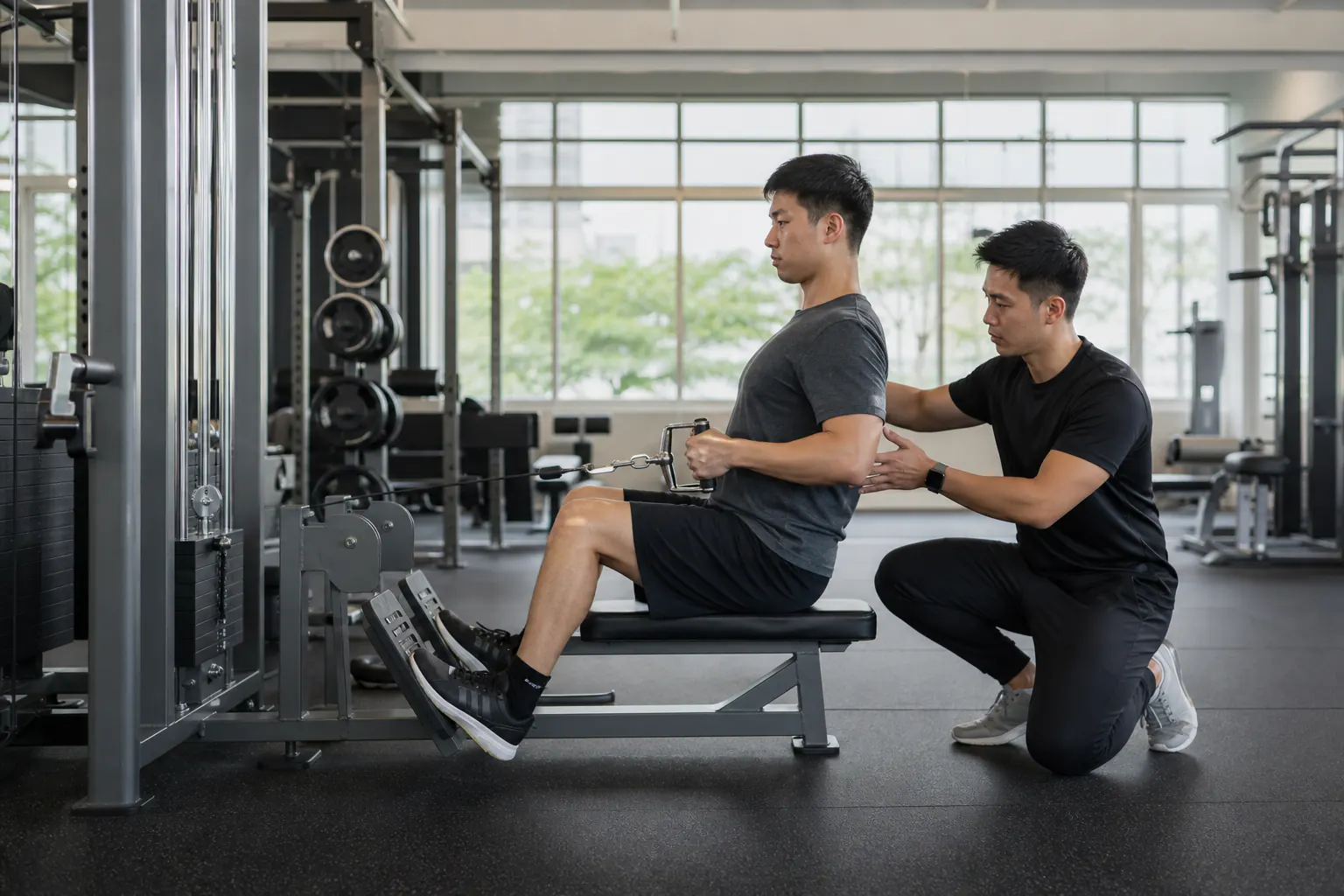
Complete arm day workout with bicep and tricep exercises, sets, reps, and supersets. Build bigger arms with this Malaysian coach's proven programme.
Arm day is the most popular training day in every gym across Malaysia. Walk into any Anytime Fitness, Celebrity Fitness, or CHi Fitness on a Monday evening and count the number of people doing curls. It's half the gym.
The problem? Most people's arm training is aimless. Random curl variations, some pushdowns, whatever machine is free, and that's it. No structure, no progression, no plan. The arms look the same month after month.
A proper arm day hits both biceps and triceps with targeted exercises, appropriate volume, smart exercise order, and progressive overload. Here's how to do it right.
Quick Anatomy Refresher
Biceps
Two heads - long head (outer, creates the peak when flexed) and short head (inner, creates width). Both cross the elbow joint. The long head also crosses the shoulder joint, which means arm position matters.
- Arms behind the body (incline curls): emphasises the long head (stretch position)
- Arms in front of the body (preacher curls): emphasises the short head
- Arms at your sides (standing curls): balanced activation
- Supinated grip (palms up): maximum bicep activation
- Neutral grip (hammer curls): shifts work toward the brachialis and brachioradialis
Triceps
Three heads - long head (largest, runs along the back of the arm), lateral head (outer, creates the horseshoe shape), medial head (under the other two, stabiliser).
- Overhead movements: emphasise the long head (stretched position)
- Pressing movements: emphasise the lateral head
- All movements: recruit the medial head at lighter loads
The Complete Arm Day Workout
Phase 1: Heavy Compound (10 minutes)
Start with the heaviest movement when you're freshest.
Close-Grip Bench Press
- 4 sets of 6-8 reps
- Rest: 3 minutes
- Grip at shoulder width. This is your primary tricep mass builder. Go heavy.
Phase 2: Superset Block (20 minutes)
Supersets alternate between biceps and triceps with minimal rest. This saves time and increases training density.
Superset A:
- Barbell Curl: 3 sets of 8-10 reps
- Overhead Cable Tricep Extension: 3 sets of 10-12 reps
- Rest 90 seconds after completing both exercises
Superset B:
- Incline Dumbbell Curl: 3 sets of 10-12 reps
- Skull Crushers: 3 sets of 10-12 reps
- Rest 90 seconds after completing both exercises
Phase 3: Isolation Superset (15 minutes)
Higher reps, focus on contraction and muscle connection.
Superset C:
- Hammer Curl (Dumbbell): 3 sets of 12 reps
- Cable Pushdown (Rope): 3 sets of 12-15 reps
- Rest 60 seconds
Superset D:
- Cable Curl (EZ Bar attachment): 2 sets of 15 reps
- Single-Arm Cable Kickback: 2 sets of 15 reps per arm
- Rest 60 seconds
Phase 4: Finisher (5 minutes)
21s Bicep Curl (1 set)
- 7 reps bottom half range
- 7 reps top half range
- 7 reps full range
- Use a weight roughly 50% of your normal curl weight
Tricep Burnout (1 set)
- Cable pushdowns: start at heavy weight, do reps to failure, drop weight by 20%, reps to failure, drop again, reps to failure. Three drops total.
Total Volume Breakdown
| Muscle | Total Sets | Notes |
|---|---|---|
| Triceps | 15 sets | Including close-grip bench |
| Biceps | 12 sets | Plus 1 set of 21s |
This session takes 45-55 minutes and provides sufficient volume for arm growth when combined with the indirect arm work from your other training days.
Key Training Principles for Arm Growth
Mind-Muscle Connection Matters Here
For compound movements like squats and deadlifts, I tell clients to focus on moving the weight. For arms, the approach is different. Slow down, feel the muscle working, and squeeze at the peak contraction.
Curling a 15kg dumbbell with strict form and a 2-second squeeze at the top will build more muscle than swinging a 25kg dumbbell with full body momentum. Check your ego at the door.
Full Range of Motion
Partial reps on curls and pushdowns are rampant. For curls: start with arms fully extended (slight bend to protect the elbow), curl all the way up until your forearms touch your biceps, then lower all the way back down. For pushdowns: start with elbows at 90 degrees, push all the way down until arms are straight, squeeze, then control back to 90 degrees.
Control the Eccentric
The lowering phase of each rep should take 2-3 seconds. Letting the weight drop wastes half the growth stimulus. Eccentric contractions cause more muscle damage (the productive kind) than concentric contractions, so slowing down the negative is arguably the most important technique adjustment you can make for arm growth.
Progressive Overload Still Applies
You need to get stronger over time, even on isolation exercises. Track your curl weights, your pushdown weights, your skull crusher weights. If you're using the same weights you used 6 months ago, your arms haven't grown.
Add weight when you can complete all prescribed sets and reps with good form. For isolation exercises, even adding 1kg matters over time.
Arm Training Frequency
How Often Should You Train Arms?
Twice per week is optimal for most people. Options:
- Dedicated arm day + indirect work from push/pull days - e.g., arm day Monday, chest/triceps Thursday, back/biceps Friday
- Two arm sessions per week - e.g., arm-focused work Monday and Thursday, lighter volume each session
- Arms added to other sessions - 4-6 sets of biceps after back day, 4-6 sets of triceps after chest day
Avoid training arms the day before or after a heavy pressing or pulling day. Your biceps need recovery before a heavy back session, and your triceps need recovery before chest/shoulders.
Weekly Volume for Arms
- Biceps: 10-16 direct sets per week (not counting rows and pulldowns)
- Triceps: 10-16 direct sets per week (not counting bench press and overhead press)
If you're doing a proper push/pull/legs split, you get indirect arm work from compound movements. Factor this in. You probably need less direct arm volume than you think.
Nutrition for Arm Growth
Arms are small muscles. They grow in proportion to your overall muscle mass. If your entire body is growing (from a caloric surplus and progressive training), your arms will grow too.
Specific requirements:
- Protein: 1.6-2.2g per kg bodyweight daily
- Calories: At maintenance or slight surplus. Arms won't grow in a deficit unless you're a beginner.
- Post-workout: Have a protein-rich meal within 2 hours of your arm session. A chicken rice from the kopitiam across from the gym works perfectly.
Common Arm Training Mistakes
Too Much Volume
More is not better after a point. Going from 10 sets per week to 15 sets per week might help. Going from 15 to 25 almost certainly won't - it'll just create fatigue and impair recovery. If you're doing 30+ sets of arm work per week and not growing, volume isn't the problem.
Only Training in the 8-12 Rep Range
Arms respond to a variety of rep ranges. Heavy work (6-8 reps) builds strength in the connective tissues and recruits high-threshold motor units. Moderate work (10-12 reps) is the hypertrophy sweet spot. Light work (15-20 reps) creates metabolic stress and targets the slower-twitch fibres. Use all three.
Ignoring the Brachialis
The brachialis sits under the biceps and when developed, pushes the biceps up, making it look bigger. Hammer curls and reverse curls target the brachialis. If all you do is supinated curls, you're missing this important muscle.
Training Arms Before Compound Lifts
Never train arms before a back, chest, or shoulder session. Fatigued biceps weaken your rows and pulldowns. Fatigued triceps weaken your bench press and overhead press. Train arms last, or on their own day.
Quick Arm Workout (20 Minutes)
Short on time? This covers the essentials:
- EZ Bar Curl - 3 x 10 (90 sec rest)
- Close-Grip Push-Up - 3 x max reps (90 sec rest)
- Hammer Curl - 2 x 12 (superset with next exercise)
- Overhead Dumbbell Tricep Extension - 2 x 12 (60 sec rest after superset)
Eight sets total. Enough to stimulate growth without overstaying.
Build your arms systematically. Track your weights. Eat enough protein. Be patient - arms grow slowly, but they do grow when the training is structured and consistent.
Part of our comprehensive guide:
The Complete Guide to Personal Training Methods in Malaysia→Also in this series:
Related Articles
Find a Personal Trainer
Ready to put this into practice? Connect with a certified personal trainer near you, or explore by service and goal.