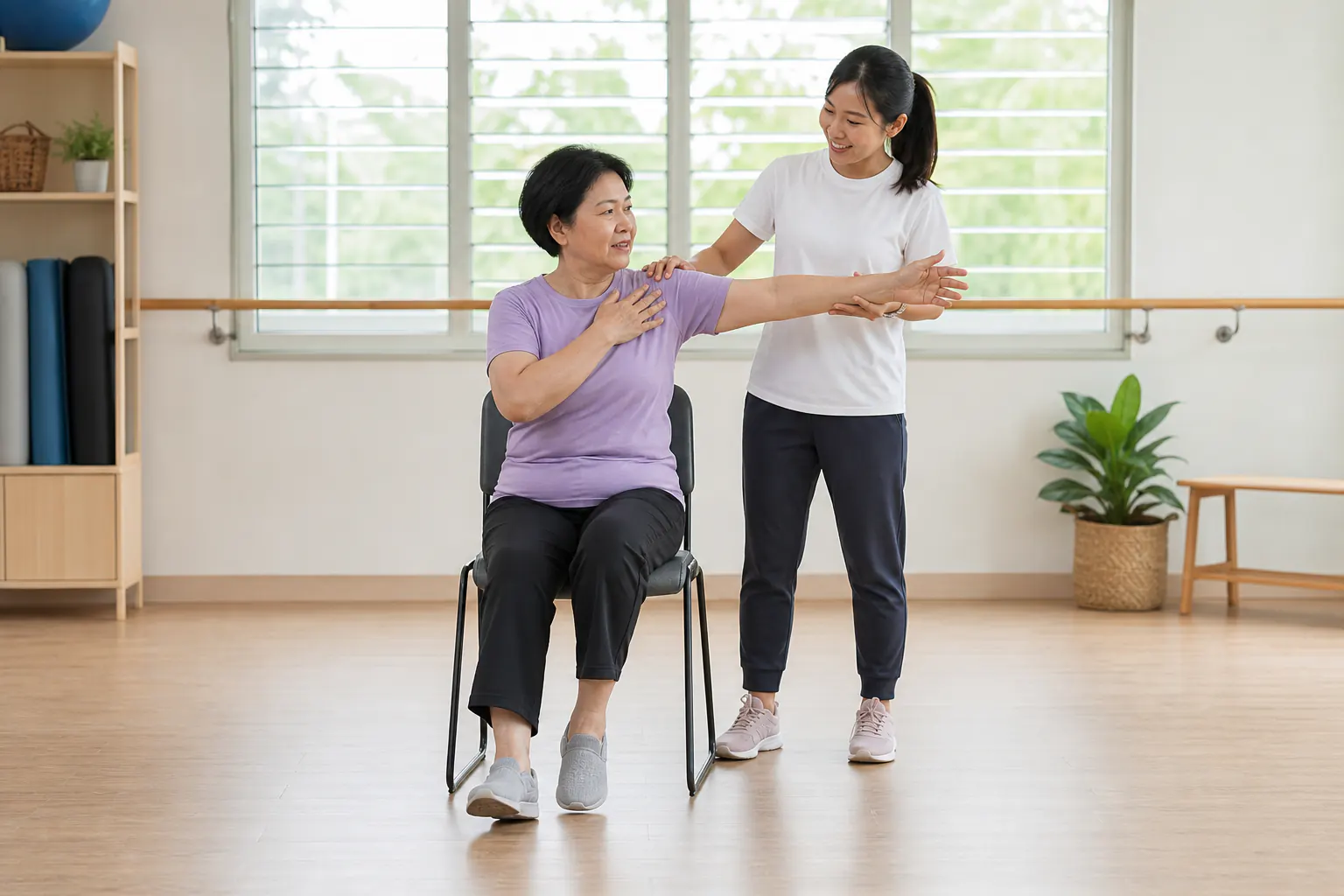
Hypermobile or double-jointed? Learn how to train safely and build the stability your flexible joints need.
If you can bend your thumb to touch your forearm, hyperextend your elbows, or touch the floor with flat palms without bending your knees, you may have joint hypermobility. While flexibility is often seen as an advantage in fitness, hypermobility presents unique challenges for strength training. Without proper programming, hypermobile individuals are at higher risk for joint instability, dislocations, and chronic pain.
Understanding Hypermobility
Joint hypermobility means your joints move beyond the normal range of motion. This is caused by more elastic connective tissue - your ligaments and tendons are stretchier than average. Hypermobility exists on a spectrum, from mild (a few flexible joints) to conditions like Ehlers-Danlos Syndrome (EDS) or Hypermobility Spectrum Disorder (HSD).
In Malaysia, hypermobility is quite common, particularly among women and those of South and Southeast Asian descent. Many people do not realise they are hypermobile because they have never been assessed.
The Beighton Score
Doctors assess hypermobility using the Beighton Score. You score one point for each of the following (maximum 9 points):
- Can you bend your little finger back beyond 90 degrees? (1 point each hand)
- Can you bend your thumb to touch your forearm? (1 point each hand)
- Can you hyperextend your elbow beyond 10 degrees? (1 point each arm)
- Can you hyperextend your knee beyond 10 degrees? (1 point each leg)
- Can you place your palms flat on the floor with straight legs? (1 point)
A score of 4 or more out of 9 suggests generalised hypermobility.
Why Standard Training Advice Can Hurt
"Lock Out Your Joints"
Standard cues like "lock out at the top of the bench press" or "full lockout on deadlifts" can cause hyperextension injuries in hypermobile lifters. When your joints go beyond their normal range under load, the stress transfers to ligaments and joint capsules rather than muscles.
"Stretch More"
Hypermobile individuals already have excessive range of motion. Additional stretching, particularly aggressive static stretching, can further destabilise joints. Yet yoga teachers and trainers often encourage hypermobile people to stretch more because they are "good at it."
"Go Deeper on Squats"
While depth is generally desirable, hypermobile lifters who squat excessively deep may lose spinal and pelvic control at the bottom. There is no benefit to squatting deeper than your muscles can control.
Training Principles for Hypermobile Lifters
Principle 1: Avoid End-Range Under Load
Stop just short of full lockout on all pressing and pulling movements. Maintain a slight bend in your elbows at the top of bench press and overhead press. Do not fully lock your knees at the top of squats and leg press.
Principle 2: Strengthen, Do Not Stretch
Your joints need stability, not more mobility. Focus on exercises that strengthen the muscles around your most hypermobile joints. Prioritise:
- Shoulders: Face pulls, external rotation with bands, scapular stability work
- Knees: Terminal knee extensions, VMO strengthening, hamstring curls
- Elbows: Bicep curls (to protect against hyperextension), wrist curls
- Core: Anti-extension, anti-rotation, and anti-lateral flexion exercises
Principle 3: Isometric Control
Include isometric holds at various points in the range of motion. These teach your nervous system to stabilise joints under load. For example, pause at the bottom of a squat for 3 seconds, or hold a plank for 30 to 60 seconds.
Principle 4: Controlled Tempos
Use slower tempos (3-4 seconds eccentric, 2-3 seconds concentric) to maintain control throughout each rep. Fast, explosive movements can push hypermobile joints past their safe range.
Principle 5: Proprioceptive Training
Balance and proprioceptive exercises teach your body to sense joint position. Include single-leg balance work, BOSU ball exercises, and exercises performed with eyes closed.
Exercise Modifications
- Bench press: Stop 2 to 3 cm short of locking out the elbows. Use a moderate grip width - excessively wide grips stress the shoulders.
- Squat: Squat to parallel, not below. Use a box to ensure consistent depth. Keep tension at the bottom - do not relax into the stretch.
- Deadlift: Stop at lockout without hyperextending the lower back or knees. Maintain a slight knee bend at the top.
- Overhead press: Do not let the bar drift behind your head. Stop at arms-extended, not locked-out.
- Pull-ups: Control the descent. Do not hang with fully extended arms at the bottom - maintain slight tension.
Seeking Diagnosis in Malaysia
If you suspect you have significant hypermobility, consider seeing a rheumatologist or a physiotherapist experienced with hypermobility disorders. In Malaysia, the Ehlers-Danlos Society provides resources, and major hospitals in KL and Penang have rheumatology departments that can assess your connective tissue health. Diagnosis allows you to train with appropriate awareness and precautions.
Hypermobility is not a barrier to training - it simply requires a smarter approach. By focusing on stability, control, and appropriate range of motion, you can build impressive strength while protecting your joints for the long term.
Related Articles
Find a Personal Trainer
Ready to put this into practice? Connect with a certified personal trainer near you, or explore by service and goal.